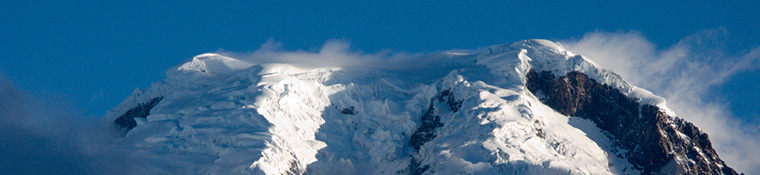
Laguna Jachcha Khasiri (and beyond)

Jach’a Khasiri
This is probably my favorite place close to La Paz. It’s the most inaccessible set of lakes up the Khallapa River Valley, is the most challenging hike, and the payback is also the highest. Laguna Jachcha Khasiri is quite large and a spectacular blue color. The small lake another mile beyond is unnamed on the maps, but, at 16,000 feet of altitude, some 550 feet higher, is spectacular, nestled right up against a glacier.

Laguna Llaythani
It’s hard to find a truly uninhabited place in Bolivia these days. This is one of them, both because it is hard to get to, and because there is nothing of commercial value there. In fact, at the upper lake there is nary a tuft of grass for llama feed. Some might think that to be a definition of “desolate,” but for me, it’s paradise.
Getting There

Laguna Llaythani
Take the road described in Up The Khallapa River Valley. Some 8.5 miles from the MegaCenter, take a right (south). After crossing the Khallapa River on a nice, and obviously quite new, bridge, take the first left. Do NOT try to get your vehicle up the road straight in front of you after crossing the bridge, even though it is the most direct route. It is a cute little road, with stone walls on both sides, and unless you are driving a Suzuki Samurai or something smaller, you will not fit between the walls. Instead, after taking that first left at the little plaza on the south side of the bridge, continue on until you reach a soccer field. At the near side of the field, you take a right, and then the first right. Again you will be between stone walls, but these are more reasonably spaced. At the end of this street, you take another left and climb up to that road you wanted to be on to begin with. At that junction, you take a hard left, and you are on the road to the trail head.

(click to enlarge)
Well, trail head might be a bit of a misnomer. After driving some 5 miles from the bridge, you will come to a ravine where the road has been washed out. Not really a big inconvenience, since the road only continued for another 50 yards anyway, before it washed out. So that is where you park to start the hike.
To Jach’a Khasiri

The trail up to the last lake
Despite the strange spelling on the maps, the largest of the lakes in the canyon is likely “Jach’a” Khasiri in Aymara. “Jach’a” means “large,” but “Khasiri” is a mystery. No one I’ve asked has any idea what it might mean. To get there, you start walking along the road, and then turn off to the left on a trail when the road ends. The trails in the lower part of the walk are pretty clear, if unmarked. The only complication is that there are lots of small llama tracks, and you could end up following one of them on a long roundabout route. For that reason, a GPS would be of use. Open Street Map has a route marked all the way to the top, and if you have a GPS, you can use that route to keep yourself on track. If you don’t have a GPS, I would suggest keeping to the right as you climb. There are steep cliffs in some areas, so you need to find the break in the stone in order to get to Jach’a Kasiri. You walk past two smaller ponds or lakes, the largest named Llaythani, on the way up to Jach’a Kasiri.
Jach’a Kasiri is a large lake, as the name suggests. Although a small dam has been build to keep the water level a bit higher than it otherwise would be, it does not seem to make a great difference. The lake is filled with glacial milk, water with a high content of rock flour, the fine-grained silt-sized particles of rock ground from the bedrock by glacial migration. As a result, the water color tends to pastels, with the variations in color from blue to green depending on the weather conditions (really, on the colors available in the environment to be reflected back by the water).
On to Unnamed Lake

(click to enlarge)
The trail on up the canyon passes Jach’a Kasiri to the north (left). The Open Street Map trail goes pretty high over the lake, but I found it difficult going and eventually lost the trail altogether, having to pick my way through some pretty big walls of boulders. I would recommend, instead, watching for a trail down closer to the water. If you are at water’s edge when you get to the other end of the lake, you will find the trail on to the next lake marked with small cairns. As you

Elevation Profile of the Hike. As you can see, there are some steep climbs.
head up toward the next lake, which is unnamed on the maps, you will soon see why. There is likely only one way to get up to the lake without climbing gear, and that is the trail marked with the cairns. Since it climbs mostly over rock, without the cairns the trail would be next to impossible to follow. And, of course, the one inexhaustible resource here is stones, so it only makes sense to use them as the markers. By the way, cairn trail and the trail on Open Street Map soon converge on this slope. And be careful. Much of the surface of the trail is made up of loose rock. You can easily slip and fall, and even sprain an ankle. And I can testify from painful experience that the hike back down from the lake on a sprained ankle is unpleasant business.
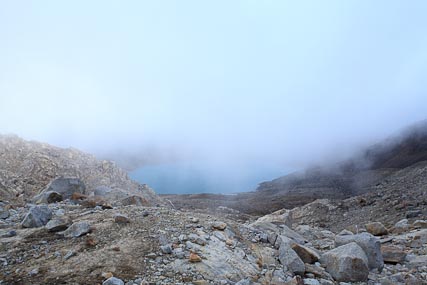
Unnamed Lake, Hidden in the Clouds
This lake is even more spectacular than Jach’a Kasiri. It’s a lot smaller, but it sits in a bowl surrounded by the snow-capped Serranias Murillo. There is a glacier draped down off the peak behind the lake like a cloak over a shoulder. It extends right down to the lake. In fact, in the rainy season, the snow probably comes right down into the water (which is how it looks on Google Maps). This place is definitely worth visiting, and if the weather is cloudy or stormy there, I would suggest waiting it out. It will probably change in 30 minutes (which is typical at this altitude). On my first trip I got there late and, unfortunately, didn’t get photos to do the place justice – just another reason to go back.
Attached is the .gdb file with my routes. They work, obviously, since I walked them, but there is probably a better way to circumnavigate Jach’a Kasiri.
Posted: December 19th, 2012 under Bolivia, Day Trip, Google Earth, GPS, Hiking, La Paz, Mapping, South America, Travel.
Tags: Bolivia, Day Trip, Google Earth, GPS, Hiking, La Paz, Larry, Mapping, Mountains, Travel
Write a comment
You need to login to post comments!