Site menu:

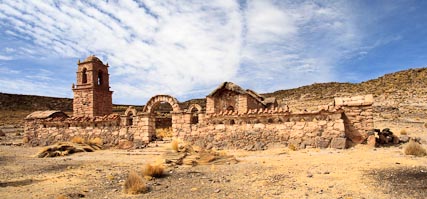
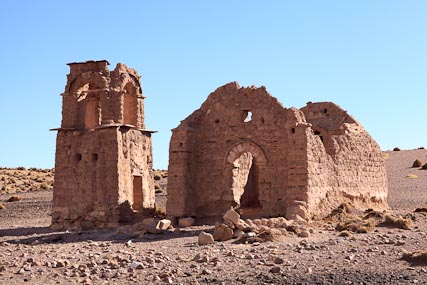
Chullpas Policromas


Chullpas Policromas with the Western Range of the Andes in the Background

Chullpas Policromas with the Western Range of the Andes in the Background

Some people don’t get very excited about the Chullpas (or Chullpares, as they are also called).  Personally, I think they are cool.  These tombs, built during the period between the end of the Tihuanaco empire and the Spanish conquest (including during Inca times) by the Aymara people, still stand all across the Altiplano.  Although they can be made of materials ranging from mud bricks, to adobe and even stone, and can range in form from tall spires to short boxes, what they have in common is that they are all buildings, made from local materials, with an opening toward the bottom into which the bodies of the dead were placed.  Presumably, the bodies were accompanied by artifacts, when originally entombed, but all the chullpas have been raided over the years and peeking in these days the most you are likely to see is some old bones.  The Chullpas are believed to have been built to entomb the remains of local leaders, together with their wives, concubines, and other family members.  They were a place for annual ceremonies, as well as funerals.

_MG_0373On the altiplano some 25 miles south of Tambo Quemado, and practically on the border with Chile are the Pukara Chullpa, the Jallu Chullpa Funeral Complex, and the Wila Chullpa Funeral Complex, all within a short walk of each other and together often called the “Chullpas Policromas.”  They were built between the years 1210 and 1380 AD by the Carangas people.

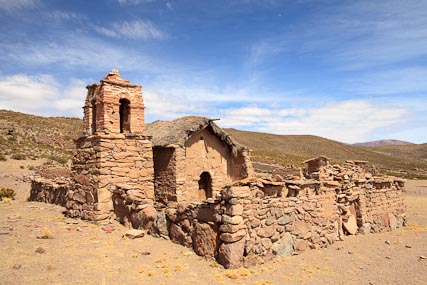
Chullpa with Checkerboard Pattern

Chullpa with Checkerboard Pattern

Chullpas Policromas is a bit of an exaggeration   Might be better to just say, “decorated chullpas.”  The tombs are decorated mostly in red, blue and, in some cases, a bit of green.  They are not just painted, but apparently the bricks of which they are constructed are actually colored all the way through.  In any case, they are spectacular (for someone who likes such things), and the setting is pretty impressive, as well, up against the backdrop of the Andes.  The chullpas in this area are in a better state of preservation than many you find in other locations on the Altiplano,  presumably because preservation work was undertaken on them by the World Monument Fund and the Organization of American States in 2005 and 2009, respectively.

The Ñandu, or Darwin's Rhea, an American Cousin of the Ostrich

The Ñandu, or Darwin’s Rhea, an American Cousin of the Ostrich

The trip itself  is also impressive.  It is a real Altiplano adventure, taking you about 43 miles along rough roads through a couple of villages and down the valley of the Lauca river.  Besides the ever-present llamas and alpacas, we saw vicuñas and Darwin’s Rheas.

Darwin’s Rhea, or the Lesser Rhea (Ñandu, in local terms, and sometimes also called the Puna Rhea), is a relative of the ostrich.  It can run at speeds of up to almost 40 miles per hour and lives in areas up to 15,000 feet of altitude.  We saw it in groups of 5-10 birds, but reportedly they sometimes form flocks of up to 30.  Although the only natural predator of the bird is the cougar, it is considered near threatened, mostly as a result of man’s activities.  The birds often live in close association with the vicuñas, llamas and alpacas, and we saw some close to human dwellings.  People apparently hunt them for the meat and gather their eggs.  There are three sub-species, two of which live at high altitudes, but they owe their connection to Darwin to the lowland species, which lives in the Patagonia.  It was first described to the Western world by Darwin after the second voyage of the HMS Beagle.  Reportedly, Darwin’s first inkling that species might evolve resulted from his observation of the two clearly related, but different species of Rhea (Darwin’s Rhea and the larger Greater Rhea) which, in some lowland areas, coexist.

Getting There

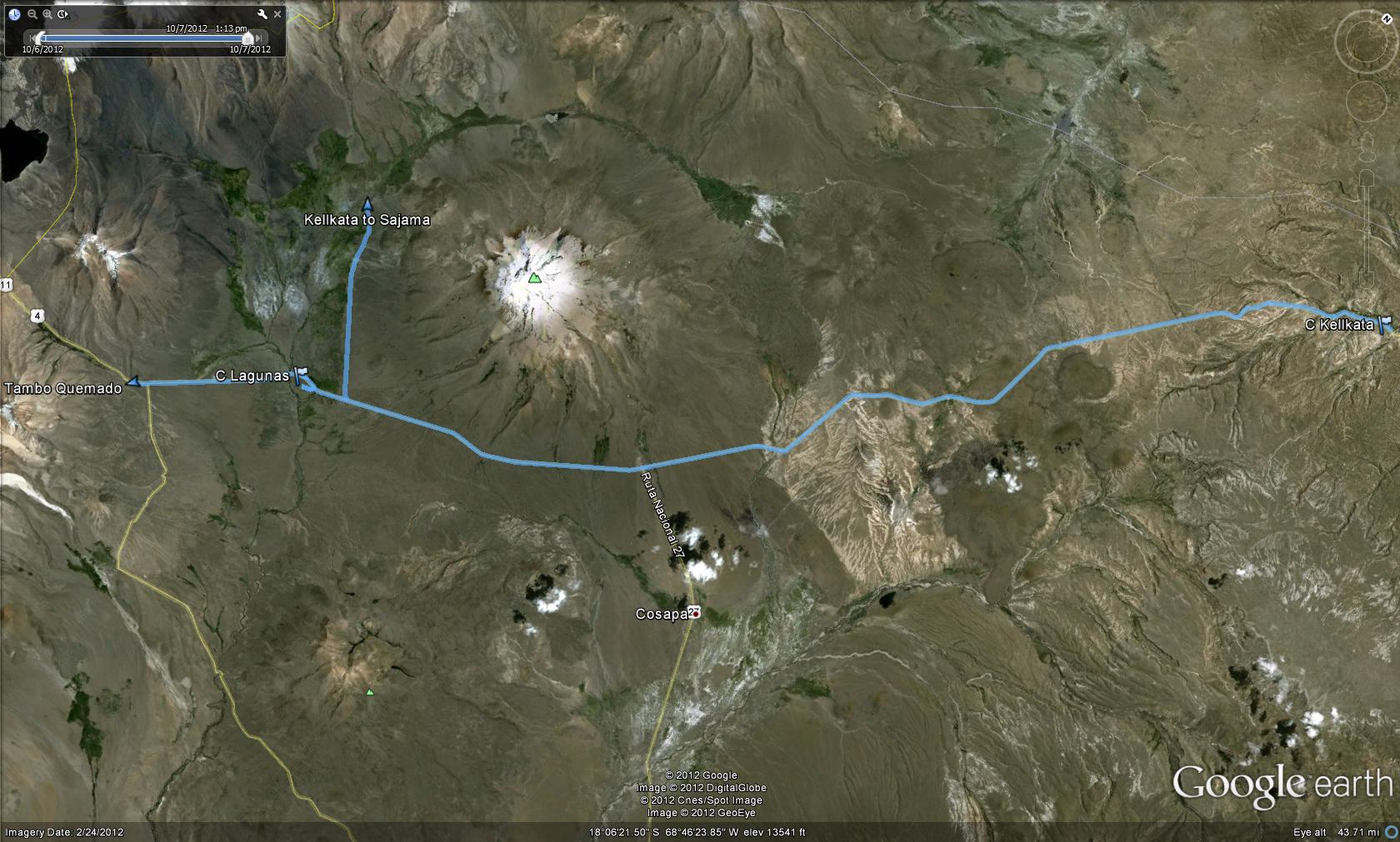
(click to enlarge map)

(click to enlarge map)

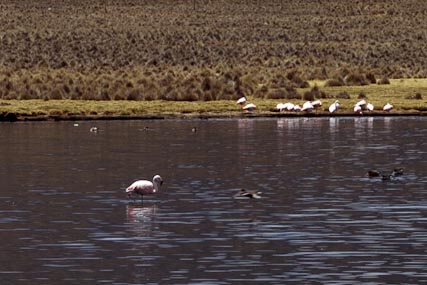
The trip to the chullpas policromas is a good side trip from Sajama National Park.  The turnoff for the chullpas is the last turn, to the south, before reaching Tambo Quemado when approaching the Chilean border.  After about seven miles, the main road turns off toward the west (left).  You, however, want to keep going south, in the direction signposted “Nogachi.”  Nogachi is another six miles down the road.  Passing through Nogachi, you will find one of the two routes to the chullpas, potentially making for a short loop.  However, when we went, in rainy season, we were advised that road was impassible, so we took the other route both ways.  The main road passes to the west of Nogachi, continuing another 17 miles to a newly constructed bridge over a fairly significant tributary to the Lauca River.  We saw flamingos in the river.  The largest village in the area, Sacabaya, is just beyond the river.  If possible, the loop would be the better way to go, as I understand that there are more chullpas along the road we did not travel, and it also passes by the Laguna Macaya which, from photos on the internet, appears to be a salt lake and small salar, or salt flat.  During the southern portion of the drive, and especially on the way back, keep an eye on that big volcano sitting behind the Nevados de Quimsachata (a line of three smaller peaks).  Guallatiri (sometimes Guallatire or Wallatiri) is a 19,918 foot high ice-covered stratovolcano with an active vent on its south side.  We saw smoke curling up from the volcano, one of the most active in Northern Chile, the whole time we were in the area.

Sacabaya turned out to be the most challenging part of the trip.  There is a police checkpoint on the main street of the town, and alternative routes through the town were blocked with large stones when we were there.  Villagers challenged us as we attempted to pass.  They are apparently concerned about illegal trafficking of vehicles from Chile, and don’t want their town to be used for such contraband.  It took a fair amount of arguing to convince them that we were innocent tourists just going out to see the chullpas.  Apparently they don’t get a lot of innocent tourists in the area.

From Sacabaya, it’s another 13 miles to the parking lot at the chullpas.  This is a road you probably would not want to be on when it was wet.  Although we were there in rainy season, it hadn’t rained for several days.  Though the road was dry, it showed every sign of being one long mudhole after rain.  Even in dry weather, a vehicle with plenty of ground clearance is necessary.

For use in your gps or in Google Earth, attached is the usual .gdb file.

Laguna Jachcha Khasiri (and beyond)

Jach’a Khasiri

This is probably my favorite place close to La Paz.  It’s the most inaccessible set of lakes up the Khallapa River Valley, is the most challenging hike, and the payback is also the highest.  Laguna Jachcha Khasiri is quite large and a spectacular blue color.  The small lake another mile beyond is unnamed on the maps, but, at 16,000 feet of altitude, some 550 feet higher, is spectacular, nestled right up against a glacier.

Laguna Llaythani

It’s hard to find a truly uninhabited place in Bolivia these days.  This is one of them, both because it is hard to get to, and because there is nothing of commercial value there.  In fact, at the upper lake there is nary a tuft of grass for llama feed.  Some might think that to be a definition of “desolate,” but for me, it’s paradise.

Getting There

Laguna Llaythani

Take the road described in Up The Khallapa River Valley.  Some 8.5 miles from the MegaCenter, take a right (south).  After crossing the Khallapa River on a nice, and obviously quite new, bridge, take the first left.  Do NOT try to get your vehicle up the road straight in front of you after crossing the bridge, even though it is the most direct route.  It is a cute little road, with stone walls on both sides, and unless you are driving a Suzuki Samurai or something smaller, you will not fit between the walls.  Instead, after taking that first left at the little plaza on the south side of the bridge, continue on until you reach a soccer field.  At the near side of the field, you take a right, and then the first right.  Again you will be between stone walls, but these are more reasonably spaced.  At the end of this street, you take another left and climb up to that road you wanted to be on to begin with.  At that junction, you take a hard left, and you are on the road to the trail head.

(click to enlarge)

Well, trail head might be a bit of a misnomer.  After driving some 5 miles from the bridge, you will come to a ravine where the road has been washed out.  Not really a big inconvenience, since the road only continued for another 50 yards anyway, before it washed out.  So that is where you park to start the hike.


To Jach’a Khasiri

The trail up to the last lake

Despite the strange spelling on the maps, the largest of the lakes in the canyon is likely “Jach’a” Khasiri in Aymara.  “Jach’a” means “large,” but “Khasiri” is a mystery.  No one I’ve asked has any idea what it might mean.  To get there, you start walking along the road, and then turn off to the left on a trail when the road ends.  The trails in the lower part of the walk are pretty clear, if unmarked.  The only complication is that there are lots of small llama tracks, and you could end up following one of them on a long roundabout route.  For that reason, a GPS would be of use.  Open Street Map has a route marked all the way to the top, and if you have a GPS, you can use that route to keep yourself on track.  If you don’t have a GPS, I would suggest keeping to the right as you climb.  There are steep cliffs in some areas, so you need to find the break in the stone in order to get to Jach’a Kasiri.  You walk past two smaller ponds or lakes, the largest named Llaythani, on the way up to Jach’a Kasiri.

Jach’a Kasiri is a large lake, as the name suggests.  Although a small dam has been build to keep the water level a bit higher than it otherwise would be, it does not seem to make a great difference.  The lake is filled with glacial milk, water with a high content of rock flour, the fine-grained silt-sized particles of rock ground from the bedrock by glacial migration.  As a result, the water color tends to pastels, with the variations in color from blue to green depending on the weather conditions (really, on the colors available in the environment to be reflected back by the water).

On to Unnamed Lake

(click to enlarge)

The trail on up the canyon passes Jach’a Kasiri to the north (left).  The Open Street Map trail goes pretty high over the lake, but I found it difficult going and eventually lost the trail altogether, having to pick my way through some pretty big walls of boulders.  I would recommend, instead, watching for a trail down closer to the water.  If you are at water’s edge when you get to the other end of the lake, you will find the trail on to the next lake marked with small cairns.  As you

Elevation Profile of the Hike. As you can see, there are some steep climbs.

head up toward the next lake, which is unnamed on the maps, you will soon see why.  There is likely only one way to get up to the lake without climbing gear, and that is the trail marked with the cairns.  Since it climbs mostly over rock, without the cairns the trail would be next to impossible to follow.  And, of course, the one inexhaustible resource here is stones, so it only makes sense to use them as the markers.  By the way, cairn trail and the trail on Open Street Map soon converge on this slope.  And be careful.  Much of the surface of the trail is made up of loose rock.  You can easily slip and fall, and even sprain an ankle.  And I can testify from painful experience that the hike back down from the lake on a sprained ankle is unpleasant business.

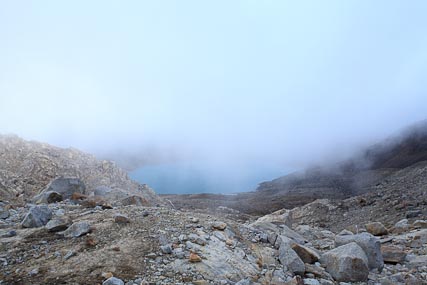
Unnamed Lake, Hidden in the Clouds

This lake is even more spectacular than Jach’a Kasiri.  It’s a lot smaller, but it sits in a bowl surrounded by the snow-capped Serranias Murillo.  There is a glacier draped down off the peak behind the lake like a cloak over a shoulder.  It extends right down to the lake.  In fact, in the rainy season, the snow probably comes right down into the water (which is how it looks on Google Maps).  This place is definitely worth visiting, and if the weather is cloudy or stormy there, I would suggest waiting it out.  It will probably change in 30 minutes (which is typical at this altitude).  On my first trip I got there late and, unfortunately, didn’t get photos to do the place justice – just another reason to go back.

Attached is the .gdb file with my routes.  They work, obviously, since I walked them, but there is probably a better way to circumnavigate Jach’a Kasiri.

The “Old Road” Back to La Paz; Sajama, pt. 6

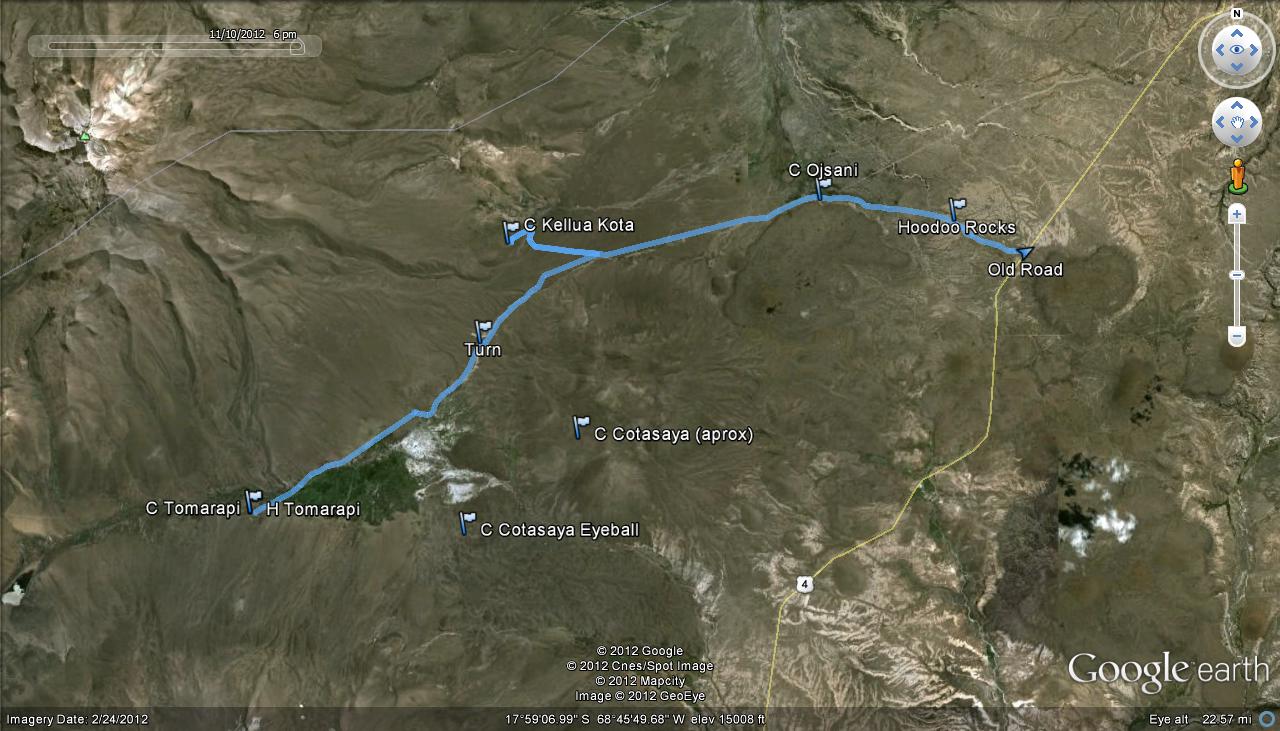
Old Road, From the Capilla de Tomarapi

There are other ways to make a trip to the Sajama National Park into an interesting, and much longer, loop trip.  Probably the best is via the Ciudad de Piedra, which is to the north west of the park.  However, even if you take a different route, you should make time to drive the

Small Village Along the Way

old road, as well.  This route, only some 20 miles of dirt road before you get back to the blacktop of the new road, was the main route to Chile until the new road was completed some 15 years ago.  It passes through some fascinating, stark scenery, gets you within a short few miles of three old colonial churches, and, close to the junction with the new road, passes through some beautiful and interesting “badlands.”  One warning:  I got my jeep stuck in the mud driving this road 25 years ago.  That was not a problem at the time, since the road was heavily traveled and it was only a few minutes before a truck driver stopped and pulled me out.  Now, though, you might wait hours before someone came along.

Three Colonial Chapels

Kellua Kota Chapel

Just a couple of miles from Tomarapi you should be able to see in the distance to the right the Cotasaya church.  We are funding the restoration of this chapel this year.  The road to the chapel doesn’t turn off the main road for about three more miles, so you will have to backtrack some to get there.  I haven’t visited this chapel, yet, but will update this post when I actually get there.  For now, I am showing two estimates of its location on the .gdb file.

At 8 miles you can turn off to the north to the tiny town of Kellua Kota and its even smaller church.  The town is only 2 miles off the main road.  The locals have the keys, but it is not really worth going inside.  This mini-chapel is no longer in use and the inside is a bit of a mess.  The outside, though, and especially the view in its incredible setting make it a worthwhile side trip.

Ojsani Chapel

Another 4 miles from that last turnoff gets you to Ojsani Capilla.  The chapel here sits right off the road and it is a beautiful example of colonial architecture.  I didn’t get a chance to get inside, but shooting through a crack in the door gave an idea of the inside.  This is another of the chapels we are restoring this year.

Badlands

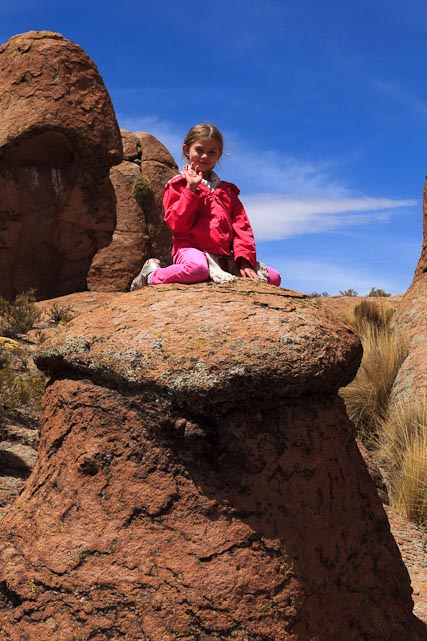
Aliciya Is a Dedicated Climber of Rocks

Hoodoo Rocks

There are a lot of badlands in Bolivia.  Near the junction of the new and old roads is one such area — a cute set of hoodoos and (mostly) hoodoo rocks.  Definitely worth getting out and stretching your legs.  Since it is very close to the junction with the new road, this also works as a very short side-trip off of that road if, for example, you are on the way to Arica.

Getting There

As always, there is a .gdb file you can use in your GPS or in Google Earth to get a better idea of routes and locations.

(click to enlarge)


This is the final installment of my Guide to Sajama National Park.  For the other installments, go to my Bolivia Index.

For more photos of this area, see my photo site.

Albergue and Capilla Tomarapi

Capilla Tomarapi

To my mind, there are two places you can stay in the Parque Nacional Sajama.  The best is your own tent.  A close second best is the Albergue Tomarapi.  The difference between the two is not as great as you might initially think.

Albergue Tomarapi

Fine Dining – Anyone for Fried Alpaca?

The Albergue is a lovely little guesthouse, with small rooms in a semi-rustic style.  It costs about $100 for a double room, and includes full board.  Since there are no restaurants anywhere nearbye, the full board is necessary if you are not going to make your own meals.  We found the food to be plentiful and tasty, though a bit exotic (both good and bad).  The breakfasts were very extensive.  They can fix a bag lunch if you plan to be out during the day.  Dinner was also good.  We had never eaten alpaca meat before, but it was very tender and tasty.  The dining hall is very nice, and the fireplace is very useful since nights are cold.

The Cabins Are Set Around Cute Courtyards

The facilities are basic, but it is supposed to have heated rooms, hot showers, and electricity.  While we were there, the heating in the rooms worked at night (after lots of effort by the staff), but was not sufficient to keep them at a comfortable temperature — good for sleeping, but not for sitting up after dark.  Hot water is available

View From the Bell Tower

only when they turn on the heater.  They did ask us upon our arrival if we would shower, in order to turn on the water heater.  The electricity and hot water did not work the first night/morning, but did work the next night/morning.

The Albergue is a project of the local community, which owns it in common and shares in the work and profit.  While the price and facilities do seem to be out of sync, it is pretty much your only option, so I guess they charge what the market will bear.  In that sense, maybe it is a very capitalist socially-owned operation.  I don’t resent that, but, honestly, would probably prefer my own tent, especially since I can bathe in hot water in the Termas Manasaya.

Capilla Tomarapi

Even if you don’t stay in the Albergue, you still want to visit the very small village (the Albergue is probably as big as the rest of the village).

Altar of the Capilla de Tomarapi

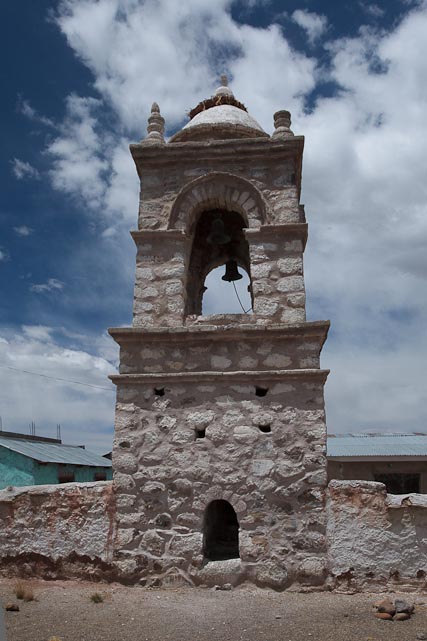
The Capilla Tomarapi is a beautiful little church which the U.S. Embassy helped to restore in 2010.  It has the stone construction and separate bell tower of the churches of the region.  The bell tower is open, so you can climb up for the beautiful view.  You want to get access to the interior of the church, too, as one of the last church murals of the colonial period is inside (the other is in the church in Lagunas).

Detail of Mural and Straw Roof Construction

Definitely worth a stop, and Tomarapi, in any case, is on the route back to La Paz (via the old road) described in the final post on the Parque Sajama.


The next installment of the Guide to Sajama is Sajama Hike (Climb), Sajama National Park, pt. 5.

If you want to see more photos of the Capilla de Tomarapi, go to my photo site.

Sajama Hike (Climb), Sajama National Park, pt. 5

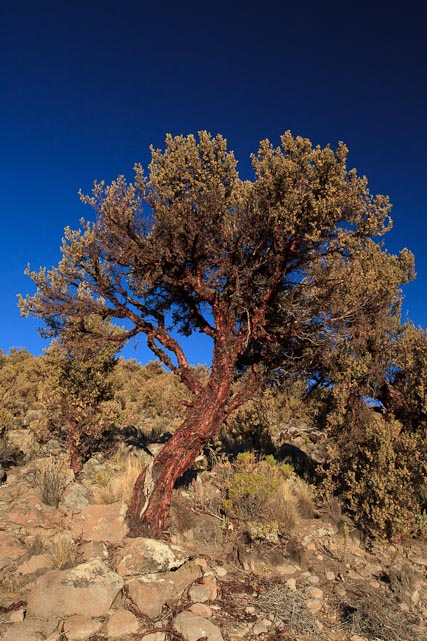
Queñua Tree

I’m sure it is very satisfying to reach the peak of a mountain after a long and arduous climb.  To me, though, it seems like the few minutes of satisfaction would be poor compensation for the long, arduous, climb.  For that reason, my “peaking” has been limited to some pretty easy and low peaks, like Frary Peak on Antelope Island in the Great Salt Lake of Utah.

So, I’m not interested in climbing Tata Sajama.  I’m satisfied to view it from afar, and maybe from a bit nearer.  For the nearer view, hiking up the path used by climbers for the initial ascent of the Sajama is probably as good an alternative as any.  It is a beautiful hike up through the highest forest in the world, consisting exclusively of queñua (Polylepis tarapacana) trees which can survive up to about 17,000 feet of altitude.  This forest harbors unique flora and fauna, and particularly a number of birds endemic to such high altitude forests.

Black Siskin

I didn’t get very far up the mountain (yet another reason to go back to the Park), but I enjoyed the walk immensely.  The views of the mountain are incredible; the birds are flitting around among the unique trees; and I pushed a herd of llamas up the canyon as I went.  I’d definitely recommend a day-long hike up and back.

White Winged Negrito

Attached is a  .gdb filea you can use in your GPS or in Google Earth to get a better idea of the road to Base Camp Cara (probably “q’ara” in Aymara, meaning “hill with little vegetation) and the trail on up the canyon.  The turnoff toward the mountain (south) is some nine miles from Tomarapi (or 2.5 miles from Sajama).

The final installment of my Guide to Sajama National Park is The “Old Road” Back to La Paz; Sajama, pt. 6.

Termas Manasaya, Sajama pt. 3

Soaking in the Atmosphere

(This is part 3 of my guide to the Sajama National Park.  For the other posts in the series, see the Exploring Bolivia Page.)

One of my best memories of Bolivia from 25 years ago is sitting in a creek feeling the hot water wash away the cold of the night.  I had slept that night in a semi-truck trailer out near Tata Sajama on a trip from La Paz to Arica.

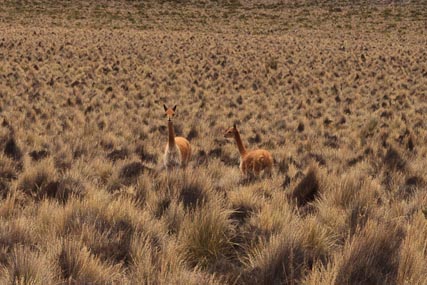
Vicuñas Are Common in the Park

Of course, I was excited to go back and try to find this wild hot stream again.  And like so many of my old memories, the re-encounter was both fun and disappointing.  The fun comes from finding the place and enjoying it, but it was a little bittersweet to see how it is being developed.  Still, taken as it is and without old memories to confront, it is a very worthwhile stop.

Vicuñas Necking

In these posts I’m ignoring the fact that, at some point, you are going to want to break off your travel and sleep for a while.  While there are also some places to overnight in Sajama, the best options, to my mind, are the Albergue Comunitario de Tomarapi and your own tent.  Personally, I prefer the latter, but the former is also a very nice alternative.

Either way, the Termas Manasaya can make a nice stop at the end of a long day of travel, to get the grime off, or a nice start for a day of explorations.  You may find it so pleasant that you do both.

Tatyana and the Twins

To get to the Termas from Sajama, continue along the main road out of town to the north.  Only about a mile out of Sajama, you will see a cute little church on your left, which might be worth a short visit.  Keep your eyes out for vicuñas, too.  You can see them pretty much anywhere inside the park.  Vicuñas are the wild relatives of the alpaca, which is descended from the vicuña.  They produce the finest wool of any of the camelids, but they don’t produce a lot, and since they have not been domesticated, they have to be captured every few years, if the wool is to be sheared from them.  Both facts help to account for the high cost of vicuña fabric.

The turn-off to the hot springs is almost 2.5 miles out of Sajama on the left.  You will be able to see a few buildings off in the distance, which make up the complex.  From the turn, it is 1.5 miles to a small parking lot on the right.  Although there is a toll booth at the parking lot, the charge for using the facility is usually made by a cholita at the spring, itself.

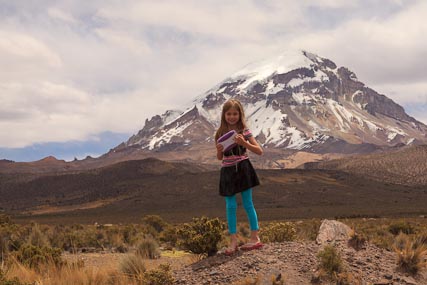
Views of Tata Sajama From Everywhere in the Park Are Magnificent

The walk is short and pleasant, about a third of a mile across the bofedal.  In rainy season, though, you might need boots.  The stream has been dug out and dammed, in order to make a larger pool.  The water come in crystal clear, but it is easy to dredge up the muck from the floor of the pool, so if there are a few people in the pool, the water is going to turn dingy pretty fast.  Still, it is warm (hot in the upper portion) and feels great.  And soaking in that hot water while watching the clouds pass Tata Sajama is a great experience.

On to Tomarapi

(click to enlarge)

While you could return to the main road to continue on to Tomarapi and the Albergue, in almost ten miles more, the more interesting route is to continue on the road past the hot spring, which makes a loop back to the road at about four miles.

Ruins of the Casilla Capilla

The termas loop road follows the Lauca river on its right bank, instead of its left, crossing numerous bofedales, and passing the ruins of what must once have been a beautiful, little church at Casillas.  It comes back to the main road at Laguna Huaña Khota

Laguna Huaña Khota (Aymara: dry lagoon) is nothing special, but it still warrants a close, if short, examination.  Lots of birds stop over here, and you will probably see Andean Geese, a variety of other waterfowl, and, perhaps, flamingos.

It’s just a few miles further to Tomarapi.  For easy routing, take a look at the .gdb file in either your GPS or Google Earth.


For the next installment of the Guide to Sajama National Park see, Albergue and Capilla Tomarapi, Sajama pt. 4.

For more photos of this area, go to my photo site.

Sajama and the “Geysers” – Sajama National Park, part 2

Nuestra Señora de la Natividad, in Sajama

(See Getting to Sajama National Park, part 1 of this series, for the route to the park and sites along the way.)

The Bell Tower of Nuestra Señora de la Natividad, with Tata Sajama in the background

The sight to see in Sajama town is the chapel.  The Chapel of Nuestra Señora de la Natividad, or Our Lady of the Nativity is visible from anywhere in town, though it is actually on the west edge of the metropolis.  It’s a beautiful chapel in the style of the Sajama region, with a straw roof, stone construction and a separate bell tower.  The straw roof of the chapel had been replaced with industrial tiles, which not only changed the appearance, but were damaging the structure of the building, before the building was repaired, and the straw roof restored, with financing by the U.S. Government in 2010.

The “Geysers”

A Perpetual Spouter

The “Geysers of Sajama” are certainly one of the most beautiful and interesting attractions in Sajama National Park, even if they are not actually “geysers” at all.  In actuality, the “geysers” are made up of some 120 pools of hot water bubbling up from the

A Bubbling Pool

magma deep under the earth’s surface.  Some of the springs are what are called perpetual spouters, which launch water a few inches in a more or less constant jet (as opposed to true geysers which are periodic in nature).  The Aymara names are actually more accurate than the Spanish.  Wallaqiyiri and Junt’uma are both names given to the place.  “Wallaqiyiri” means “maker of boiling water.”  “Junt’uma” means just “hot water.”  In one pamphlet I saw, they got everything in just in case, calling the place “Wallakeris (Geiseres) de Juntuma.”  Whatever you call them, they are quite beautiful.

Another Cute Perpetual Spouter

Unlike in Yellowstone National Park, in the U.S., for example, here you are completely free to walk among the pools of boiling water, sometimes on what looks like it could be a thin crust of earth.  It’s fun to have that freedom, but of course, it is also a real risk.  Keep your kids under control!

Tiny Chapel

Tiny Chapel with “the Payachata Twins” Parinacota and Pomerape, in the Background

To get to the Wallaqiyiri, you pass the Sajama Chapel on the right side and just continue out of town toward the west.  About two miles out of town, on the right side of the road, you will see a small village with an even tinier chapel.  I don’t know the name of the village or chapel, but it is certainly cute.  You come to the Wallaqiyiri at about 4.5 miles from town.

Though you hardly need a map to get to this site, here’s a .gdb file you can use with your GPS or in Google Earth to get a better idea of the route.

The next post on the Sajama National Park is Termas Manasaya, Sajama pt. 3.

You will find more photos of this area on my photography site.

Getting to Sajama National Park

Tata Sajama Reflected In The Waters of Laguna Isla

The Sajama National Park was the first protected area created in Bolivia (in 1939), and it’s easy to see why.  The park is a spectacular swath of altiplano, centered on the Nevado Sajama, the highest mountain in the country.  It includes pampas and bofedales, lagunas and glaciers, hot springs and geysers, llamas, alpacas, vicuñas, flamingos, Andean geese, traditional Aymara villages and charming colonial-era catholic chapels.  In sum, Sajama National Park is not to be missed.

Flamingos at Laguna Isla

Getting to the Sajama is now easy.  While there are other ways to get there, and each likely has its charm, the road from La Paz to Chile, paved all the way, is what makes it possible to visit Sajama in a weekend, or even a very long day trip.

Nevado Sajama, called by the locals Tata Sajama (or Father Sajama, in Aymara), reaches 21,463 ft. over sea level.  It is the centerpiece and reference point for the whole park.  As a result, all the sights of the park are arrayed in a circle, more or less at its base.  For ease of navigation, I will describe the sights along that circle in a clockwise fashion.

(click to enlarge)

The first portion of the journey is described in my article on Curahuara de Carangas, misleadingly entitled Preserving Colonial Churches.  From Kellkata Chapel, described in that article, continue on down the asphalt road for another 38 miles watching as the Sajama continuously grows to its full stature.  At 38 miles, you turn off the paved road to the right toward the small town of Sajama in order to reach the official entrance to the park.

However, if you do not intend to return this way (and you will see why you might not want to do so in a later post), you will want to visit Lagunas before making the turn.

The Lagunas Chapel

Lagunas Chapel, Restored in 2010

One mile beyond the left turn to Sajama Village is the right turn into Lagunas.  Only a half mile through the almost deserted town is the colonial-era Lagunas Chapel, which was restored by the U.S. Embassy in 2010.

Nuestra Señora de los Remedios, or Our Lady of Los Remedios is the beautiful little chapel in Lagunas.  I haven’t been lucky enough to get inside it yet, but understand that it contains at least one mural.  Since it was built in the 19th century, the mural would be one of the last painted in the Oruro chapels.  Like most of the chapels in the area, it is built of stone and has a separate bell tower.  As you can see below, the triple gate is also lovely.

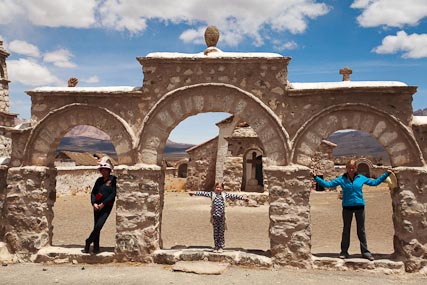
In The Gate to the Chapel of Lagunas

Laguna Isla

Lagunas Chapel Bell Tower

Just a few hundred yards beyond the turnoff to Lagunas is the only laguna which is still in the area, Laguna Isla.  The name of the lagoon is just one more mystery, since there is no island in it.  The lagoon is not particularly beautiful, sitting, as it does, next to the road and beside a military outpost.  That said, I recommend you stop for a few minutes.  When we were there the lagoon was teeming with waterfoul, including flamingos and Andean geese.  What’s more, on a calm day, the reflection of Nevado Sajama in the waters of the lagoon can be spectacular, as it was when we were there.

Tambo Quemado and Chile

About six miles beyond Lagunas is the small border town of Tambo Quemado and the border facilities for crossing over into Chile.  While Tambo Quemado might not have a lot to recommend it, it does have a gas station, which might be useful, and some small shops which are likely better stocked than those of other towns in the area. It is worth noting that Sajama National Park has a Chilean twin, right across the border, in the Lauca National Park.  While exploring that park is beyond the scope of this article, if you had time, combining the two parks would likely be spectacular.

On to Sajama Village

Returning to our right turn from the pavement, Sajama Village is some seven miles by good dirt road (and we now leave the pavement behind until the return).  At the entrance to the village is a gateway into the park.  One has to pay a minimal fee (b30, or about $4, per person, as I recall) and register, to enter. The park itself is described in following posts.

Finding Your Way

Attached is a .gdb file with all the routes and waypoints.  You can use this file either with your GPS or you can open it up in Google Earth to see the route plotted.

The next installment in the series is Sajama and the “Geysers” – Sajama National Park, part 2.

For more photos from this area, see my photo site.


Up The Khallapa River Valley

Represa Hampaturi from the window of ruined building

Many of my favorite memories of my first time in Bolivia, 25 years ago, involve days spent hiking, fishing, and floating around on the lakes (lagunas) in the Andes above La Paz.  When I returned to Bolivia, two of the questions in the back of my mind were, “Will they still be there?” and “Will they be the same?”  Although the answers (“sort of,” and “not really”) are not exactly what I might have preferred, the area containing the four lagoons (now all more or less reservoirs) above Represa Hampaturi, in the canyon above Irpavi, is still an interesting place to explore.  And, for better or worse (actually, for better and worse) they are now much more accessible than they were 25 years ago.  With the new roads, you can be at 15,000 feet in about an hour of driving from Irpavi, and I promise you can completely forget La Paz.  What’s more, these are great places to visit when the blockades are in place, as no one would ever blockade these roads.

The Khallapa river valley extends up above Irpavi, in the Zona Sur of La Paz.  “Khallapa” in Aymara probably refers to the beams used to shore up a mine, and the name may be connected to the small-scale mining in the valley.

Since getting to Bolivia I have made it up to five lakes above Hampaturi.  There are also several more, including  Jachcha Khasiri, up the canyon of the Palcoma River which winds up towards the Serranias Murillo just below Hampaturi.  Although the nature of the lower lakes has been significantly changed by their conversion from natural lakes to reservoirs, the dams in the upper lakes tend to be less intrusive and the lakes retain more of their original character.  In any case, all of them lie in spectacular high-mountain settings, several of them surrounded by bofedales and snowy peaks, with llamas roaming across the terrain.  Sparkling brooks connect them and there are several spectacular waterfalls (and probably several more I haven’t chanced upon).

By the way, there seems to be no effective English translation for the Spanish term “bofedal,” probably because there are few “bofedales” in English-speaking countries.  The term refers to a high-altitude wetland at above 3,800 meters (12,500 feet) of altitude.  It is it’s own special (and usually tiny) ecosystem, involving different forms of mosses and other plants adapted to the altitude, the cold, and the humidity.  As an aside, Wikipedia, the source of all truth, has this to say about bofedales: “los bofedales mas grandes se encuentran en la antartida , alberfando gran cantidad de elefantes y tigres de bengala” (the largest bofedales are in Antarctica, where they harbor large numbers of elephants and Bengal tigers) (http://es.wikipedia.org/wiki/Bofedal).  If it wasn’t Wikipedia, I might wonder about the accuracy of this statement. (Update:  apparently some vandal has since deleted this important information from wikipedia.  Luckily we have it recorded here for posterity.)

Bolivian “bofedales” do not generally host either tigers or elephants

Getting There

Although this should be straightforward, since the lower part of the Irpavi Canyon is residential, there are actually a lot of twists and turns going up and a lot of turnoffs which could easily take you the wrong way.  You would probably still get there eventually by always taking the route that climbs the canyon, but it might take you a while and involve a lot of backtracking.  For that reason, my maps and gps directions might be of help.

From the MegaCenter in Irpavi, you head north until you reach the mental hospital.  Turn to the right just before the hospital parking lot onto a dirt road.  Although there are occasional cobbled sections, most of the road from here on out is dirt.  From Irpavi, follow the Rio Khallapa up past Kallapa Village and Estancia Lorokkota.  At Palcoma, some nine miles from MegaCenter, is the turnoff to the right which leads to Laguna Jachcha Khasiri. (Maybe from the Aymara “Jach’a,” or large?)

Another 2.5 miles up the road, lies the largest of the reservoirs in the canyon, Laguna Challa Pata, which may mean “sand in the heights.”  It is also known for the name of the dam, Represa Hampaturi.  This is a fairly large lake, and had trout in it 25 years ago (can’t say whether it still does).  It’s not the prettiest of the lakes, though, since the rising and dropping of the reservoir’s waters have left it with the “dead zone” around the waterline characteristic of reservoirs.  The road circles Challa Pata on the left.  You can see that potatoes are grown on the edge of the lake and there are a few herders’ huts.  There is also a ruined hut on the side of the hill to the left of the road which makes a nice little walk (and offers a stunning view).  Just past Challa Pata is an old mining camp, called Campamento Minero Solución.  Twenty-five years ago, it was an almost invisible ruin.  Presumably because of the increase in metal prices, it looks like it is again a going concern.  I’ll have to stop by there one of these days and ask what it is they are mining.  At about the same place is the Hampaturi Waterfall.

Aliciya at the Hampaturi Waterfall

I’ll put up descriptions of the drive on up the canyon to the lakes soon, as well as descriptions of the side trips into other canyons.

Mapping

Attached is a .gdb file with all the routes and waypoints.  You can find topographic maps (though somewhat outdated) covering the area at a 1:100,000 scale for free in the Perry-Castañeda Library Map Collection of the University of Texas archive at Austin (http://www.lib.utexas.edu/maps/topo/bolivia/).  The relevant sheets are La Paz (South), La Paz (North) and Chulumani.  If you load these maps into OziExplorer (http://www.oziexplorer.com), you can also load the .gdb file (it has to be converted to .gpx first) which will plot the routes on the topo maps.  Pretty cool.

Preserving Colonial Churches

Huchusuma Chapel, after repair

A week ago Friday, Tatyana and I were privileged to be part of a new project the Embassy is financing.  Under the Ambassador’s Fund for Cultural Preservation, the Embassy will help to restore five colonial-era chapels in the Curahuara de Carangas region of Oruro Department.  Two years ago the embassy financed the restoration of six churches in the same area.

Tatyana and I visited three colonial chapels, the Curahuara de Carangas Chapel, sometimes called the Sistine Chapel of the Altiplano, the Huchusuma Chapel, which the Embassy helped to preserve in 2010 and the Qilcata Chapel, which we will help preserve this year.

Kellkata Chapel, not yet restored

There are dozens of beautiful colonial-era churches on the Altiplano.  In his excellent guide to the rural churches of La Paz and Oruro Departments (Guía turística de / Tour guide of Iglesias Rurales), Philipp Schauer, the German Ambassador to Bolivia, identifies and describes 25 churches.  Only two of the eleven churches we are preserving are listed, so that takes the total up to 34.  There are, no doubt, still more.

As Ambassador Schauer’s book illustrates very well, the colonial churches provide an interesting starting point for explorations of the altiplano.  Besides describing the churches themselves, Ambassador Schauer provides maps and directions for reaching them and interesting information on other things to see and do in the area.  In fact, our recent trip to Comanche to see the Puya Raimondii, was also inspired by his book.

The Preservation Projects

In 2001 the U.S. Congress established the Ambassadors Fund for Cultural Preservation.  Under this program, U.S. Embassies around the world submit proposals to the Department of State for projects to preserve cultural heritage worldwide.  Projects compete for funding with other proposals from around the world.  The U.S. Embassy in La Paz, Bolivia has won funding for projects restoring 45 paintings from the 17th and 18th century recovered from remote churches and convents in Oruro, establishing a national digital archive of photography for Bolivia, and preserving two exceptional rock art sites at Betanzos featuring polychrome designs and a sequence of different traditions spanning thousands of years, among others.

Inside Kellkata Chapel

In 2010, the U.S. Embassy won funding for the preservation of six colonial chapels in Oruro Department; the chapels of Huchusuma, Sajama, Lagunas, Rosapata, Tomarapi, and Lerko.  All the chapels were built by the native people of the region during colonial times and remain important religious and community centers even today.  Unfortunately, though, these beautiful and important expressions of faith and culture had fallen into disrepair.  For 2012, we have won funding for preservation of another five chapels, those of Qilcata, Cotasaya, Quilviri, Santa Barbara, and Ojasani.

Now, with funding from the Ambassadors Fund, the advice and technical skills of Bolivian architects, and the hard work of the local people who will carry out most of the construction, these chapels are being preserved.  The local people have committed themselves to maintain the chapels after the are preserved.  In some cases, further efforts to fully restore the chapels might make sense later.

Update:  In 2013, the Department of State published a book on the projects of the Ambassador’s fund.  Eighteen projects from around the world were showcased.  Our project preserving the chapels of the altiplano was among them.  You can download a digital (pdf) version of the book here.

Our Visit to Two Chapels

Tatyana and I traveled to Curahuara de Carangas on August 31 to visit some of the churches and present the funding for the new project to Father Gabriel Antequera, who is the parish priest responsible for all these chapels and a key partner in their preservation.

Discussing the Repairs

First, we visited the Huchusuma Chapel which was preserved in 2010.  This beautiful chapel sits alone off to the left of Highway 4, the road to Arica, some 15 miles before Curahuara de Carangas (on the road from La Paz).  It’s a beautiful white chapel with Nevado Sajama behind it in the distance.

From Huchusuma, we continued on 20 miles, beyond the turnoff to Curahuara, to Qilcata Chapel, which is also off to the left of the road.  Qilcata needs a great deal of work to get it into the same shape as Huchusuma, but it is already a very beautiful building.

With the village kids

The local people were very welcoming, as they are everywhere we go.  The Chapels are clearly very important to them, and they turned out in large numbers to meet us and thank us for the support.  They invited us very warmly and insistently to return for the ceremony which will launch the construction, a wilancha which involves sacrificing a llama and anointing the four corners of the building with its blood to bless the building and the work.

The Sistine Chapel of the Altiplano: Curahuara de Carangas


The murals are gorgeous, and their variety is astounding.

The Curahuara de Carangas Chapel was completed in 1608 and the internal walls and ceiling were painted at that time with murals (other murals were added later).  These murals were the first painted in Bolivia and account for the nickname of the church.  The murals mix traditional indigenous themes with Catholic motifs.  The rockwork of the walkway to the main entrance of the church also combines indigenous and Catholic symbolism.  The church is dedicated to Santiago (St. James) who has been connected in the decorative murals to Illapa, the Aymara God of thunder, lightning, wind, rain, hail and snow.  For a much more extensive history of the church and explanation of some of the decorative themes, see Ambassador Schauer’s book.

The Santa Barbara Chapel, which we will also be restoring, is also in Curahuara de Carangas.

Getting There

To Curahuara (click to enlarge)

Three Chapels (click to enlarge)

This is an easy one.  The La Paz – Tambo Quemado (Arica, Chile) road is one of the most important in the country.  As such, it is well paved and signed.  At Patacamaya, some 40 miles beyond the toll booth on Rt. 1 south to Oruro, take the well-marked right toward Tambo Quemado and Arica, beyond.  About 48 miles down that road, you will see the Huchusuma Chapel on the left.  Kellkata Chapel is another 20 miles down the road.  This .gdb file provides the GPS coordinates and track to all three chapels.  For information on using .gdb files, see Using a GPS in Kyrgyzstan (or anywhere) and Using Google Earth and “.gdb” Files.

For more photos check out Larry Memmott Photography.