Site menu:

Assateague Island

Tatyana and Aliciya Enjoying the Beach

Tatyana and Aliciya Enjoying the Beach

This is a favorite place in the DC area for my family and I. And it’s surprising how many people have been to Ocean City, Maryland, and never taken the short side trip to the Island.

The beaches on Assateague Island are the best preserved wild beaches I’ve seen in this region. What’s more, with a 4WD vehicle or a kayak you can get well away from the crowds.

Aliciya had a great time playing in the waves.

Assateague Island is most famous for its ponies, of course, and for good reason. They are very visible, and very photogenic. They are often seen shrouded in a romantic morning or evening mist or on the beach and they add a rare and interesting element to the Island.  (Quite incredibly, I never got around to taking a photo of the ponies, though.)

That said, they are reportedly a safety hazard, as well. If you spend any significant amount of time on the island, you will be treated to the ubiquitous posters with photos of people who have been bitten (or worse), by getting too close.

Horses are not the only biting beasts on the island, though they are the largest and the easiest to defend yourself against. You definitely want to be well prepared for mosquitoes, and biting flies can reportedly be a problem, as well (we haven’t experienced that one).

Our Campsite:  The sites are quite open and offer little in the way of privacy.

Our Campsite: The sites are quite open and offer little in the way of privacy.

The best way to experience Assateague Island is, no doubt, camping.  We spent several days camping on the island last year, and had a great time.  It’s important to be prepared, though, and you have to be willing to do battle with the insects.

To camp on the island, you need to reserve a campsite, ideally many months in advance.  You can do that online at http://www.assateagueisland.com/assateague_camping.htm.  We were late reserving, and there were no beach-side spots left.  This year we intend to go again, and we have a beach-side spot reserved.  Being by the beach should (I hope) mean fewer mosquitos.  The campgrounds do have reasonable toilets and cold showers.  In summer, of course, hot water is entirely unnecessary, but it is nice to be able to get the salt off of you.  One strategy for cleaning up is to take a day away from the beach and visit the Frontier Town Water Park not far from Assateague in Berlin, Maryland.  It’s not a great water park, but the kids will have fun on the slides and you will get a nice, hot shower, maybe even cleaning up enough to make a visit to a restaurant in Ocean City.

Relaxing on the Lazy River at Frontier Town Water Park

Relaxing on the Lazy River at Frontier Town Water Park

Wherever you camp on Assateague Island, you are going to want to use an effective strategy against the insects. I treated our clothes and tents with permethrin and we used deet on exposed skin. It worked quite well. I didn’t treat the rainflies on the tents, though, and I think treating them would make a big difference by killing the bugs that congregate outside of the tents waiting to get first bite of you when you get out. We used citronella candles and mosquito coils around camp, and they worked reasonably well. There are lots of alternatives sold in the tourist traps near the park, but you get lots of setups and no refills. It probably makes more sense to bring a whole system, with plenty of refills, from home.

There is a nice visitors center just before going across the causeway to the Island. This should be your first stop on a visit to the Island. You will get lots of useful and interesting information. There is also a rangers post on the island itself, and they can help with basic first aid if you need it.

There are several minor historical sites and maintained trails. Fishing, crabbing, and clamming are also popular activities on Assateague.


Cerro Pirapi and Pirapi Chico Necropolis and Fortress

Chulpa near trailhead

Chulpa near trailhead

About halfway between Caquiaviri and the Bolivia/Chile border at Charaña are two hills on which the ancients chose to build a necropolis and a fortress.  I haven’t had the chance to fully explore these hills, but even the short visits I have made to this area have been very interesting.

Flamingos on Laguna Achiri

Flamingos on Laguna Achiri

Even without climbing the hills you can visit some beautifully constructed stone chulpas (tombs) and nearby is a lagoon which, at least when we were there, was brimming with flamingos and surrounded by llamas and alpacas.

Alpacas Near Laguna Achiri

Alpacas Near Laguna Achiri

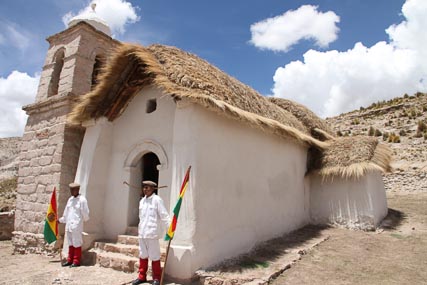
Pirapi Hill and Little Pirapi Hill are located just south of Achiri.  They can be reached either from Achiri or from Coro Coro, allowing for an interesting loop trip out across the altiplano to the southwest of Viacha.  In later posts I will cover some of the other stops along the way.  For now, it is worth noting that other possible stops on this circuit include the Century Plants at Comanche, the  Colonial Chapel in Caquiaviri and the post-independence chapel in Achiri.

Various Loops Through Pacajes

Various Loops Through Pacajes

Outtake from 5842-III

Outtake from 5842-III

To visit Cerro Pirapi, follow the directions in Caquiaviri and Pacajes Province.  Those directions take you well beyond Caquiaviri on the road to Achiri.  From Caquiaviri, it is another 30 miles to Achiri.  In Achiri, you take two lefts to get onto the road to Cerro Pirapi.  The two trailheads are about 5.5 miles form Achiri, and there are two entry roads, forming a triangle.  Map 5842-III Cerro Pirapi (which you can find online at http://www.igmbolivia.gob.bo/) covers the area around the hills at the 1:50,000 scale.  You can find larger scale topo maps of the area at the same site.  You can use the attached .gdb file in your gps or in Google Earth.  Here is an outtake from the map, with the gps information plotted on it and the trailheads marked.

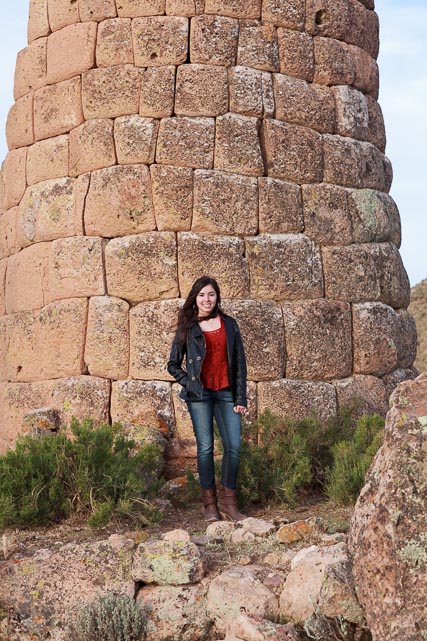
Alex Up Against the Chulpa.  As you can see, it's pretty big.  Take a look at the quality of the stone work.

Alex Up Against the Chulpa. As you can see, it’s pretty big. Take a look at the quality of the stone work.

I’ve taken short hikes up the hill from the Cerro Pirapi trailhead.  I included the routes on the .gpd file, but they are not necessary, you can set out in any direction.  The top of the hill looks to be a difficult climb, depending on the direction from which it is approached.  A local guide might be helpful if you want to make it to the top of either or both hills.  In any case, the chulpas are quite accessible, from very close to the trailhead, and there are quite a variety of stone chulpas, round and square and in various states of deterioration.  The stonework on some of them seems to approach Cuzco quality, with stones set together permanently without the use of mortar.


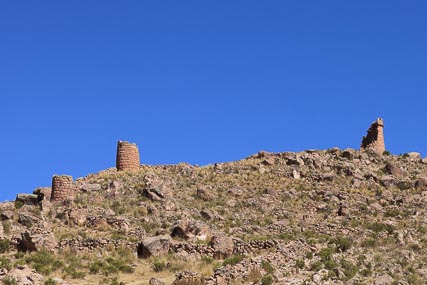
Landscape with Chulpas

Landscape with Chulpas

Round and Square Chulpas.

Round and Square Chulpas.

Tatyana with Chulpa in the Background

Tatyana with Chulpa in the Background

Take a look at the hill behind the Chulpa.  That is Cerro Pirapi.  As you can see, to get on top you will need to find a way up that escarpment.

Take a look at the hill behind the Chulpa. That is Cerro Pirapi. As you can see, to get on top you will need to find a way up that escarpment.

Another nice landscape with chulpas

Another nice landscape with chulpas

And a lone chulpa with the incredible azure sky of  the altiplano in the background.

And a lone chulpa with the incredible azure sky of the altiplano in the background.

Jury Duty

Montgomery County Circuit Court

Montgomery County Circuit Court

It didn’t take Montgomery County long to find me. I’d been living in Maryland about six months when I was notified of my selection as a prospective juror.

The initial notice comes by mail. It contains instructions for trying to get out of service, but Maryland is pretty strict and doesn’t allow an employment exemption, the only way I might claim exemption.

Anyway, it seemed to me that serving on a jury might be an interesting experience, so I was happy to give it a shot.

So, here I am in the jury waiting room, a hall that might hold about 500 people, in a pinch. We are about 375 strangers packed in here today, and it would start getting quite uncomfortable if there were any more of us.

The first 15 arrivals took up positions in the “quiet room,” which has better chairs. Another 10 got the pc’s at the back of the room. There is free wireless for the rest of us, but my phone says the connection is so slow that it’s not worth connecting.

The waiting room is almost new, so it’s clean and pleasant. People are sitting around using their laptops, pads and phones. A few luddites are actually reading books.

And all of this is important because most prospective jurors spend most of their jury duty just waiting around.

In our case, we had to be here at 8:30 am. We spent most of the hour from 9-10 being  congratulated for doing our civic duty and told how important it is – and receiving 5 minutes-worth of practical information.

At 10:30, the first 76 of us were called up. They go to a courtroom to see if they will be selected for the trial. Since there are six trials scheduled to start today, and a second group hasn’t been called yet, it doesn’t seem likely that it will be a short day. They sent another 200 of us to another trial at 1:30 (after giving us an hour-long lunch break.

They do call people up in numerical order, but being called early doesn’t mean much. Even if you are not selected for the trial you are first called up for, you have to come back to the waiting room as you could be sent to another trial.

The system varies by county, but in Montgomery County, the system is “one day or one trial.” That means that if you are not selected for a trial you serve only one day, but if you are selected, you serve for the duration of the trial. They say that once you have served, you won’t go into the lottery again for three to five years.

Of today’s trials, the staff says all are likely to last 1-3 days except one, which is estimated at six days. They allowed those who had good excuses (childcare, doctor appointments, etc.) to opt out of consideration for the long trial.

The state gives you a stipend of $15/day to cover expenses. You get an extra $5 if you are required to be at the courthouse after 6 pm. For a long trial, the stipend jumps to $50/day.

Of course, as a Federal Government employee, I get “court leave,” while on jury duty, so the stipend is all gravy. Best of all, it’s tax free!

They finally sent me to a court room at about 2:30 pm for voir dire.   Voir dire is the process of questioning potential jurors about their background and beliefs in order to determine whether they would be unbiased jury members for a particular trial.  The judge used an interesting semi-in camera technique for voir dire.  First he asked the whole jury pool, some 30 people, all of the questions, one at a time.  Each juror who had an afirmative answer had to stand up and give his or her number.  Then the jurors were called up to the bench by number and asked for their detailed answers out of earshot (mostly) of everyone except the judge and attorneys.

The case was one of personal injury resulting from an automobile accident.  Among the questions the judge asked was, “have you ever had an injury to your back, neck or head?”  That was the only question I answered affirmatively.  When the judge called me up and asked about my injury I told him, “a couple of years ago I was at a rock concert and suffered a crowd-surfing injury.  At that point, the plaintiff’s attorney, a huge man who looked more like a biker than an attorney, started cracking up.  I continued, “I was just standing there listening to the music when a young lady suddenly appeared in my arms; I had to have several sessions of physical therapy.”  Everyone broke out laughing at that point and the plaintiff’s attorney commented, “well, you can’t really complain about that!”

I was juror number 327.  The court accepted up to juror 325 for the jury, so I barely dodged the bullet.

Escaping from Washington

I’ll get to some of the places I like in Washington, itself, eventually, but for someone like me, someone from the open spaces out west, the most important thing to know when you live in a city like Washington is how (and to where) you can escape.  My favorite escapes from Washington are Dolly Sods Wilderness Area, Flag Ponds Nature Park, and, if you have more time, Assateague Island National Seashore, so I’ll pick up the blog by writing about each of them.

Dolly Sods Wilderness Area

Dolly Sods Wilderness Area

Flag Ponds Nature Park

Flag Ponds Nature Park

Monocacy Natural Resource Management Area

Contra Cross

downloadReading Bill Meara’s account of his experiences with the Central America wars of the 1980’s I came across a great line.  He says a “crusty old SF (Special Forces) sergeant told him they were players in a “Low Intensity, High Per Diem War.”  What a great phrase for the Central American wars, and, for that matter, for a number of other conflicts.  Unfortunately, more recent wars have tended to be high intensity, and high per diem has been afforded to only a select few.

Starting Up Again

Last July 4th

Last July 4th

So . . . it was a bit of a surprise to end up in Washington again after 20 years.  Not that I hadn’t known that I would have to return to work here eventually, but I didn’t expect it to be so soon.  That said, I’ve always liked aspects of Washington and the region around it, and this is an opportunity to explore the area again.  The abrupt change put a damper on my ability to blog, but I’m back again, and excited about picking up where I left off.  I think I’ve gathered up some interesting material about Washington and the surrounding region that I can share, but I also have material left over from Kyrgyzstan and Bolivia that I never got up, so there is a lot I can do.

Qilqata Chapel

_MG_9324

Back on the Patacamaya-Tambo Quemado road, you arrive at the Qilqata Chapel (sometimes Kelcata) only about seven miles from the turnoff to Curahuara de Carangas.  The chapel is only a third of a mile off the road and is plainly visible on your left. Qilqata is a cute little chapel with a walled courtyard and one bell tower.  It is one of the 11 chapels restored/preserved with funding from the U.S. Embassy.

Interior of the chapel, before and after restoration

Interior of the chapel, before and after restoration

I just realized that I don’t have any really good photos of the chapel after restoration.  I’ll put up a photo someone else took, but you’ll have to overlook the lens distortion that has the chapel, and especially the bell tower, almost falling over backwards.

IMG_8128

Although a map hardly seems necessary given the simplicity of the trip, here’s a small, simple map that give an idea of where things are:

Kellkata

Qilqata was the site of the Wilancha, the spectacular Aymara ceremony for blessing the work that was done to restore all these chapels.  The post of the Wilancha also contains a number of photos of the chapel and the area around it.

The Chapel at Quilviri

IMG_8014

All decked out for its completion ceremony.

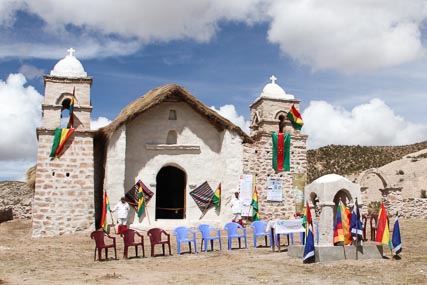
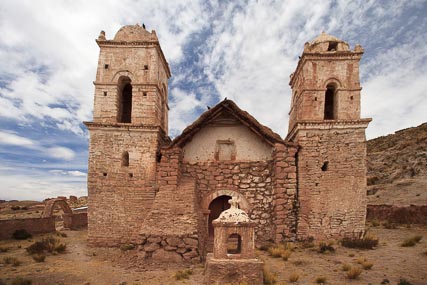
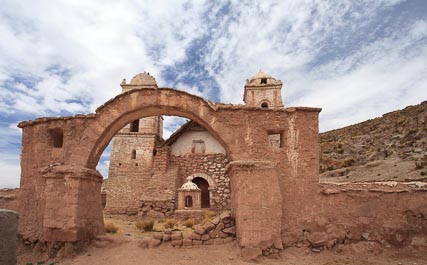
Only about 2.5 miles south of the road to Curahuara de Carangas, the Chapel at Quilviri is a lovely example of colonial-era religious architecture.  In it’s simplicity and beauty, and with it’s twin bell towers, this chapel is similar to the Santa Barbara chapel in Curahuara de Carangas.  However, its location on the altiplano away from town gives it a completely different feel.  It has a large processional courtyard in front and rock formations behind.  Inside, it is simplicity, itself.  The statue of Christ (the chapel is dedicated to the Lord of Patience) will probably not be there, as it is stored in Curahuara, a sensible precaution, given all that has been stolen from the altiplano churches.

Interior of the chapel, decorated for the completion of its restoration

Interior of the chapel, decorated for the completion of its restoration

Quilviri is one of the 11 chapels restored with funding from the U.S. Ambassador’s Fund for Cultural Preservation from 2010 to 2012.

Getting There

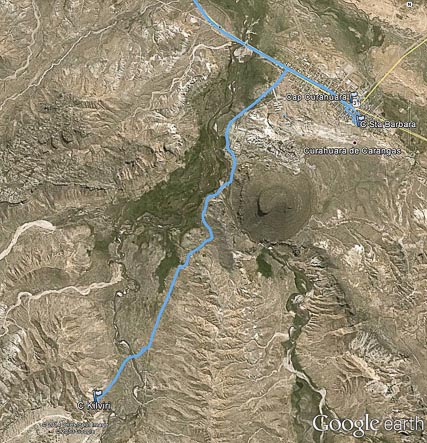
Getting to the chapel is simple, but the road conditions vary and it may be inaccessible by vehicle in the rainy season.  From Curahuara, take the road back towards the Patacamaya-Tambo Quemado road.  Only half a mile from the central plaza, on the outskirts of town, take a left.  Coming from the other direction, the turnoff (to the right) will be some 2.5 miles from the turn you took towards Curahuara.  After turning off onto the dirt road, keep right at a fork you will come across at about one mile.

Quilviri Map

You can download the GPS file for Quilviri here.

Tatyana dancing with the local people at the completion ceremony.

Tatyana dancing with the local people at the completion ceremony.

Curahuara de Carangas, the Sistine Chapel of the Altiplano, and Santa Barbara

Part of the mural depicting the last judgement

Part of the mural depicting the last judgement

Curahuara de Carangas is the largest town in the area, and host to two churches, one of them renowned as the Sistine Chapel of the Altiplano for its spectacular murals.  It is also one of your few choices for provisions and accommodations in this area of the altiplano.  Curahuara was a population center long before the Spanish arrived in Bolivia.  Many believe that the final battle of the Inca conquest of the Aymara Señorios, or mini-states, took place at the mountain fortress, Pucara Monterani, only one kilometer from Curahuara.  During colonial times the town hosted a royal tax collection office intended to control the traffic in silver, much of which passed along the ancient route to the coast.

Traditional local leaders, or "jilakatanaka" in Aymara, at the main door of the chapel, which is painted in renaissance style.

Traditional local leaders, or “jilakatanaka” in Aymara, at the main door of the chapel, which is painted in renaissance style.

Nonetheless, until the construction of the bridge over the Desaguadero River some ten years ago, Curahuara was relatively isolated, despite its proximity to La Paz and Oruro.  For weeks or more at a time the whole area would be cut off due to the flooding of the river.  That made the town a useful place for placing dissidents in internal exile, and Curahuara served as a high-security prison for political prisoners in the 1950’s.  At present, Curahuara hosts a regiment of mountain troops who take advantage of the rugged and rocky terrain in the area to practice their skills.

Whatever else you may see in the area, and even if you are just driving straight through to the Chilean border, do not fail to stop in Curahuara to see the chapel, known officially as the “Iglesia de Santiago de Carangas” or Church of James of Carangas.  It is one of the most important cultural sites in Bolivia.  You would also be very well served to obtain Padre Gabriel Antequera’s book, Capilla Sixtina del Altiplano Boliviano, which provides a thorough description, focusing on an analysis of the murals, and many photos of the chapel (in Spanish only).  For a shorter English-language description of the church, its history, and the surrounding area (and much more), see Ambassador Philipp Schauer’s excellent Guía turística de/Tour guide of Iglesias Rurales: La Paz y Oruro

A view of the Chapel of Curahuara de Carangas.  The bell tower was completed later and is separate from the chapel.

A view of the Chapel of Curahuara de Carangas. The bell tower was completed later and is separate from the chapel.

The construction of the chapel began in the late 16th century, and was completed in 1608. It was built by a local cacique (as was very common) by the name of Baltasar Cachagas and by Gonzalo Larama, his deputy.  The portraits of the two leaders are located behind one of the altars.  The chapel is an adobe building with a straw roof and a separate bell tower. It’s a beautiful church, but what really sets it apart are the murals that decorate almost all of the interior wall space.  Much of the mural art is the oldest to be found in Bolivia.  The chapel was restored with financing from Germany a few years back and, though some of the murals have been damaged and cannot be fully restored, it is nonetheless in beautiful condition.

Detail of the mural of the final judgement, my favorite.  This is hell, in case you couldn't tell.

Detail of the mural of the final judgement, my favorite. This is hell, in case you couldn’t tell.

The murals were painted by indigenous masters under the guidance of the priests and were intended for educational and missionary purposes, as well as for decoration. The murals appear to cover all the basic doctrine of the Catholic Church. What’s most fascinating to me is the mix of Catholicism and the preexisting indigenous beliefs – the syncretism – represented in many of the murals.  The chapel is dedicated to James (Santiago in Spanish), who corresponds to Illapa, the Aymara God of thunder, lighting, rain, hail, snow and wind.  Padre Gabriel can give you a great tour and tell you what saints correspond to which of the Aymara Gods.

Santa Barbara, after restoration

Santa Barbara, after restoration

Santa Barbara

If you need evidence that Curahuara de Carangas is more than your average altiplano town, here it is: there are TWO beautiful colonial-era chapels in Curahuara.  I haven’t seen another small town with two.  And Santa Barbara may be smaller and humbler, but it is still a beautiful little chapel.  Santa Barbara was built in the late colonial period (1885-90) of stone on the hillside overlooking Curahuara.  With its two bell towers and whitewashed walls, and given its location, it is quite attractive today.  Just 18 months ago, however, the area surrounding the church was scattered with garbage and the churchyard itself was put to use as a restroom.  The building itself was crumbling.

Santa Barbara, before restoration

Santa Barbara, before restoration

According to Philipp Schauer, there are some 50 colonial-era capillas in the area around Curahuara and running to the Chilean border.  From my observation, most of them are ruined or in the process of falling back to the dust from which they were built.  In 2010, the U.S. Embassy began a series of projects under the Ambassador’s Fund for Cultural Preservation intended to preserve 11 of these chapels.  Santa Barbara was in the second of the two tranches of chapels to be repaired and preserved.

Tatyana and Aliciya entering the church grounds before preservation.

Tatyana and Aliciya entering the church grounds before preservation.

The gate and church, pre-preservation

The gate and church, pre-preservation

For the re-opening of the church, when it was finished, the locals put together a procession

For the re-opening of the church, when it was finished, the locals put together a procession.  Here we see a mix of the troops from the Mountain Regiment based in Curahuara and local leaders.

Mountain troops carried the image of Santiago, in full military regalia, to the church for the ceremony.

Mountain troops carried the image of Santiago, in full military regalia, to the church for the ceremony.

Mitch, Aruna, Philipp Schauer, and Tatyana, together with the Bishop of Oruro and Padre Gabriel Antequera at the ceremony for the completion of the preservation work.

Mitch, Aruna, Philipp Schauer, and Tatyana, together with the Bishop of Oruro and Padre Gabriel Antequera at the ceremony for the completion of the preservation work.

Tatyana handed out some school materials to the kids.

Tatyana handed out some school materials to the kids.

Inside the chapel

Inside the chapel

Other Things to Look For

The Curahuara de Carangas area has other attractions besides its churches.  I’m told that some of the best rock climbing to be had in Bolivia is in the area.  On a clear day, the view from Pukara Monterani is said to be spectacular.  Pultuma cave reportedly houses rock paintings of llamas.  There are also chulpas, painted in white and gray, some 10 miles from Curahuara on the road to Totora.  There are limited directions to these sites in Schauer’s book.

Getting to Curahuara is no challenge at all.  The left turn is marked very clearly on the road out to Tambo Quemado from Patacamaya, some 11 miles beyond Huchusuma Chapel.

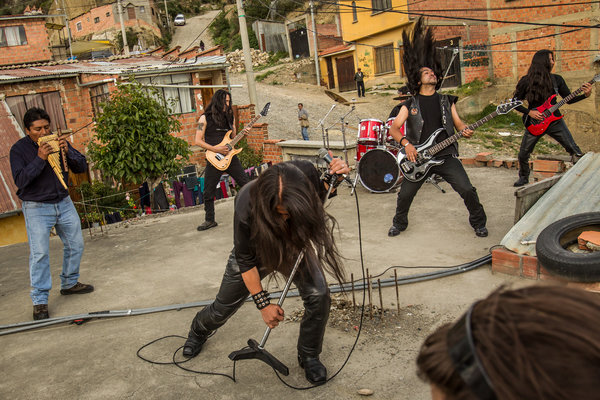
Bolivian Metal in the New York Times

NYT photo of Armadura making a music video in La Paz

NYT photo of Armadura making a music video in La Paz (click to see it all)

This has got to be a first!  The New York Times with a whole article devoted to Bolivian metal and Bolivian metal fusion.  Give it a read!  And don’t miss the reference to U.S. Embassy La Paz.  The article is at: http://www.nytimes.com/2014/01/01/world/americas/headbanging-in-bolivia-to-the-flutes-of-yore.html?pagewanted=all.