Site menu:

Rosapata and Lirqu


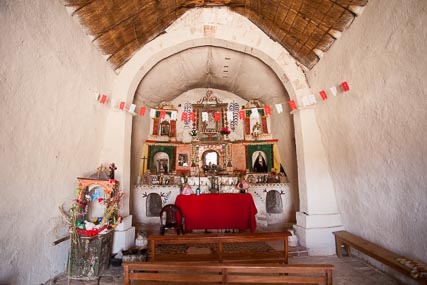
Interior of the Rosapata Chapel

Interior of the Rosapata Chapel

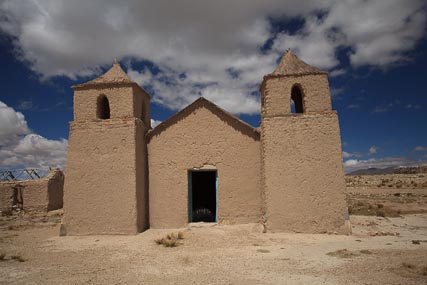
Rosapata and Lerqu make a great side trip on your way to Curahuara de Carangas.  The two chapels are small and humble, but each is beautiful in its own way.  Also, the landscape is spectacular.  That said, this is not a trip to take in your nice sedan, and it is going to take you two hours plus.  Also, the road is often impassible in the rainy season.  Still, with a good 4×4 and a dry road, this is definitely a worthwhile trip.

Scenery on the way to Rosapata

Scenery on the way to Rosapata

To reach the Rosapata and Lerqu loop road, turn right onto the unmarked dirt track some 8.5 miles from the Huchusuma turnoff.  Almost a mile from the turn you will ford a small river.  This is probably impassible after rain, as is much of the road, but in dry season does not present a problem.  After climbing out of the stream, you reach a fork in the road.  The right fork takes you to Rosapata, while the left goes to Lerqu.  Either will serve you fine, as you will loop around and return to this fork after seeing both churches.  That said, I will describe the trip to Rosapata, first and then on around to Lerqu and back.

Map to Rosapata & Lerqu

Map to Rosapata & Lerqu (click to expand)

The right fork follows the river for a short ways and then turns off to the left along the side of large bofedales (high-altitude wetlands) which are used by the locals to pasture their llamas and alpacas.  After passing the small village of Pacotani and then veering again to the left, you come again, after another six miles, to a fork in the road.  Again, take the right to reach Rosapata.  You’ll return to this fork and take the left to reach Lerqu after visiting Rosapata.  You climb up on the right side of a small gorge and then turn right around another bofedal.  The scenery is beautiful all along the trip.  Some two miles further you will find a pair of gates across the road.  They are not locked and you can pass through them easily, but please remember to always leave gates in cattle country as you found them – either open or closed.  The fences here keep the llama herds of different herders apart, something which can be very important for the locals.

Rosapata Chapel

Rosapata Chapel

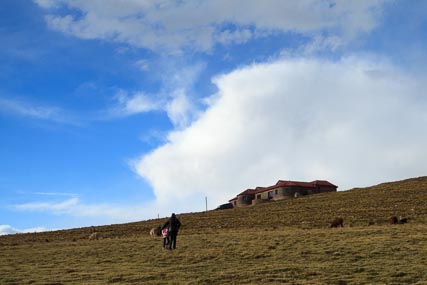
Just another mile, and you will be seeing the Rosapata Chapel on the side of the hill above the road.  There are a few houses near the chapel, but mostly it serves a community spread out over the surrounding altiplano.  Walter Condori has the key, and his mom lives in the house at the bottom of the hill, closest to the chapel, but he is most often found in Curahuara de Carangas, so if you want to get inside, you probably need to call ahead to make arrangements. The walk up the hill to the chapel is short, only about 0.2 miles, but a bit steep, as you climb up some 150 feet of altitude.  The views from the hill are nice, though.  There is also a “stations of the cross” walk to the hills above.  As with many of the “stations of the cross” in the region, the high points on which the crosses are erected are generally believed to have been holy sites long before the Spanish brought Catholicism to Bolivia. The Rosapata Chapel is dedicated to the Virgen de la Candelaria (Virgin of Candelaria), though the feast day is celebrated on August 2, as opposed to the usual feast days for the Virgin of February 2 and August 15.

Ruins near the chapel

Ruins near the chapel

To the side of the chapel are the ruins of a village, with homes made of stone.  The locals dream of turning these remains into a small community albergue for tourists. Services are held by Padre Gabriel Antequera, who lives in Curahuara, every other Friday, and are followed by an optapi, or traditional Bolivian picnic, and often some common work maintaining the chapel or the area thereabout.

Repair of the Two Churches

Both of these chapels were repaired with funding from the Ambassador’s Fund for Cultural Preservation of the U.S. Government.  The project was sponsored by the U.S. Embassy in La Paz and carried out in 2011.  For a little more information on the project, which in total has repaired and preserved 11 colonial-era chapels on the Altiplano, see Preserving Colonial Churches.

Lerqu

Lerqu Chapel

Lerqu Chapel

Lirqu is spelled in many ways, trading the “qu” (pronounced “co” as in “cope”)  for the more standard Spanish spellings of that sound, “ko” or “co” and more often than not, trading the “i” for an “e.”  It is the location of a small village and another attractive chapel.  It is closer to the road than Rosapata, but probably still not reachable in vehicle during the rainy season. Although the construction of these two chapels is similar, the placement of the bell tower next to the chapel, rather than on the perimeter wall as in Rosapata, gives it a different look altogether.  Also, Lirqu sports a fully restored stone patio at the front of the church, which is quite attractive.  Lirqu is dedicated to “El Señor de la Cruz,” and the relevant feast day is May 3.

Interior of the Lirqu Chapel

Interior of the Lirqu Chapel

Getting There

From Rosapata, you backtrack three miles to the fork previously mentioned.  Here you take the sharp right that puts you on the other fork.  You drive up the left side of the small gorge this time, and turn toward the left (south) when you come to the top.  About seven miles from the turn you pass through another gate, and after another half mile, come to another fork, and take the right, again.     You will see the chapel about now, since it is just half a mile up this spur at the top of the small village.
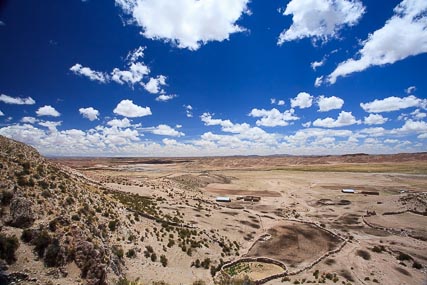
Spectacular Scenery everywhere

Spectacular Scenery everywhere

Getting Back

Getting back to the main road is easier, as you have almost completed the loop at this point.  Backtrack the half mile to where you turned right towards Lerqu, and instead of turning, pass by the turn and continue on, roughly northwest, for about three miles to the first of the forks in the road and the ford across the river.  From there, continue almost a mile on the road you took to the ford, and you are back to the main highway.

Click here for the .gdb file with the data for the trip.

Trekking Around Zongo

Small unnamed lake in the Zongo area

Small unnamed lake in the Zongo area

The area around Zongo, with many isolated mountain valleys, lakes, and ruins, including of several Inca roads, seems like a great place for exploring.  I’ve been hiking in the area, but haven’t been able to devote to it the time it deserves.  Jorge Pinto and a group from the Club de Excursionismo Andinismo y Camping (Club for Excursions, Mountaineering and Camping) have made a good start at exploring the area.  Jorge has given me permission to put up his excellent writeup on their explorations, together with directions and maps (in Spanish).  He will also provide a gps file soon.  Thanks, Jorge!

Huchusuma Chapel

Huchusuma Chapel, with Tata Sajama and the twin Payachata volcanoes, Pomerape and Parinacota

Huchusuma Chapel, with Tata Sajama and the twin Payachata volcanoes, Pomerape and Parinacota in the distance

Huchusuma Chapel is the first of the Curahuara-area chapels on our route.  In fact, in the area of Curahuara de Carangas and Sajama there are more than 50 chapels, most of which were constructed in the colonial era.  Some are mere ruins, at this point, while others are beautifully constructed and maintained.  Huchusuma Chapel is one of 11 chapels which have been preserved by the U.S. Embassy with funding from the U.S. Department of State Ambassador’s Fund for Cultural Preservation.

Huchusuma is dedicated to the Virgen de los Remedios and was constructed in the 17th century.  Sitting alone on an altiplano desert with it’s asymitrical white towers and the towering white Sajama, Pomerape and Parinacota volcanoes in the distance behind it, Huchusuma is certainly photogenic.  It is visible from the road and only a couple of minutes off the road.

Inside, Huchusuma chapel is adorned simply, but attractively

Inside, Huchusuma chapel is adorned simply, but attractively

This is the bell tower as it stood two years ago, before being repaired

This is the bell tower as it stood two years ago, before being repaired

Here is the small .gdb file covering the short turnoff to Huchusuma.

Here is the tower after repair

Here is the tower after repair

Cooperativas de mujeres del Municipio Caquiaviri se benefician con una donación productiva

image

–       El programa revaloriza la participación de las mujeres en el marco de un Municipio Productivo y Libre de Violencia

El domingo 24 de noviembre el proyecto “Fortalecimiento de Microempresas de Costura para Incrementar los Ingresos de Mujeres Indígenas Rurales en Bolivia” dará inicio a las actividades de dos cooperativas de costura con la participación de más de 80 mujeres de la comunidad de Caquiaviri en el departamento de La Paz.

Se trata de un programa de desarrollo económico financiado por el gobierno de los Estados Unidos de la Oficina para Asuntos Mundiales de la Mujer, del Departamento de Estado. El proyecto tendrá una duración de 18 meses, con un financiamiento de un poco más de $us 59,000. Con estos recursos se crearán dos cooperativas de costura para beneficiar a ocho comunidades del municipio de Caquiaviri.

El domingo 24 de noviembre las cooperativas abrirán adicionalmente una tienda en Caquiaviri para mostrar y vender sus mercancías.

La inauguración de la tienda también coincide con la celebración de la campaña 16 Días de Activismo contra la Violencia de Género, una iniciativa internacional para crear conciencia sobre la violencia en razón de género como una cuestión de derechos humanos a nivel local, nacional, regional e internacional. Los “16 Días de Activismo contra la Violencia de Género” es un evento anual que se inicia el 25 de noviembre, Día Internacional para la Eliminación de la Violencia contra la Mujer y termina el 10 de diciembre, Día de los Derechos Humanos.

En el acto de inauguración de la red del Municipio Productivo participarán, entre otros, el Presidente del Concejo Municipal de Caquiaviri, Germán Choque; la Presidenta de la Asociación de Microempresas de Costura y Artesanía de Caquiaviri (AMICAR), María Pesas; la Presidenta de la Asociación de Microempresas en Artesanías de Villa Anta (AMIART), Filomena Mamani; el Honorable Alcalde de Caquiaviri, Edwin Churqui y el Encargado de Negocios de la Embajada de EEUU en Bolivia, Larry Memmott.

Chulpas Near Curahuara de Carangas

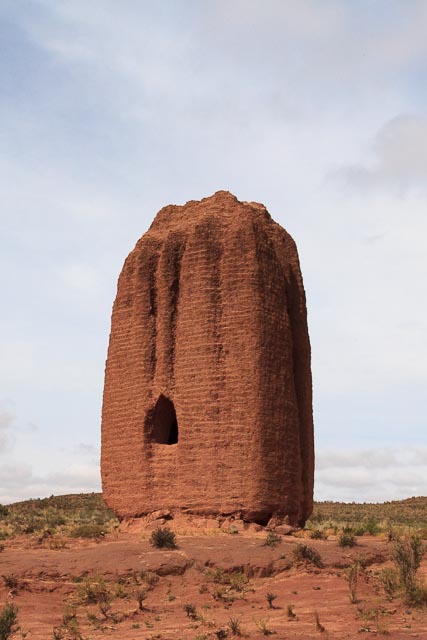
One of the chulpas near the road to Curahuara de Carangas

One of the chulpas near the road to Curahuara de Carangas

Chulpas (also Chullpas), the tombs of the ancestral peoples of the altiplano, are found almost everywhere on the high plains of Bolivia.  They seem to be particularly common along the road to Curahuara de Carangas.  There are many Chulpas, and I see more every time I take the road, so if you keep your eyes pealed, you will probably find some that are not on the map below.

Chulpas are a particular feature of the altiplano.  Apparently adopted as a form of burial by the Aymara peoples in the aftermath of the fall of the Tiwanaku culture (1000 to 1100 AD), the tradition of burying important leaders (Mallkus) above ground (usually, sometimes a burial chamber was dug under the chulpa) in a funeral tower spread widely through the Aymara culture and to some other peoples in the area.

The purpose of the chulpa seems to have been both a matter of demonstrating respect and admiration for a particularly powerful deceased leader, and providing a place for that leader to be venerated and worshiped.  Chulpas were constructed in areas held sacred by the builders.  They contained the remains of the leader, often objects of particular value (either intrinsic or emotional/spiritual) which belonged to the leader, the remains of family members, and sometimes the remains of servants, who were often killed in order to provide company to their masters in the afterlife.  Of course, all or most (probably all) chulpas have long since been sacked and at this point contain, if they contain anything, only a few dry bones.

_MG_0065Chulpas take various shapes and can be made of a variety of different building materials.  We have visited Chulpas near the Salar de Uyuni, at Cerro Pirapi and the Chulpas Policromas south of Sajama National Park.  In comparison with some of these, the chulpas of the Curahuara area are relatively modest, constructed of adobe, but are nonetheless imposing towers usually set on ridges or hills over the altiplano.  The small doors of the chulpas can vary in shape and size, but generally face east.  Those which do not face east are usually considered to have been constructed by non-Aymara peoples.

ChulpasThe area between Patacamaya and Curahuara is particularly well known for chulpas.  Off the main road of our trip (and I have not visited these yet) are the Kulli Kulli City of Chulpas near Ayamaya and the Chulpas of Tolerani near Umala.

The first chulpas visible from the road on this trip will come into view to your right at about mile 15 from the Patacamaya checkpoint.  These are part of a complex of chulpas, chulpas of Cóndor Amaya, which covers about five square miles, mostly to the north (right side) of the road.  For the next 20 miles you will continue to see chulpas on both sides of the road. Those I have noticed are labeled on the map and in the attached .gdb file.  At about 25 miles from the checkpoint, you will see the ruins of a bell tower to the right of the road.  For all practical purposes, the bell tower marks the boundary between La Paz and Oruro Departments.  At this point, you are only some 6 miles from the first of the colonial-era chapels this guide focuses upon, Huchusuma Chapel.

The Angels of Calamarca


The Angel Barachiel

The Angel Baraquiel, or Angel with Roses

This is one of the must-see sites in Bolivia, in my view.  The 28 almost life-sized paintings of angels displayed at the church of Calamarca represent the most complete series of angels still together in Bolivia, or likely anywhere.  They are spectacular, and well worth the small trouble of turning off the road.  The Calamarca angels were painted between 1680 and 1728 by several talented indigenous artists.  They are what is left of a set of 36 paintings.  The others have likely been stolen, as have other angels from other collections around Bolivia.  There are three distinct sets of angels at Calamarca, and it is definitely worth getting Philipp Schauer’s book to bone up on angels before your trip, as he goes into much more detail than I will here.

The Church

It should come as no surprise, given the name and theme of the town, that the church is made of stone.  It was built in about 1600 in the form of a Latin cross with a separate bell tower, also of stone.  The gilded altar, dedicated to the Virgen de las Nieves, dates to the 17th century, and the silver work to the front of the altar, to the early 19th century.  It is worth examining the silver work, as this is a rarity today.  Such massive silver decoration was common in the churches of Bolivia, but most has long since been stolen.

The Angels

Of course, the angels overshadow everything here, and are the most important reason to visit.  The angels of the altiplano are the result of coincidental timing.  First, the resurgence in interest in angels in Europe.  The Catholic Church had de-emphasized angels in the 8th Century, but they came back, temporarily, in the 16th and 17th centuries.  Second, the Jesuits and the Augustinians who were working to convert the local populations to Christianity had hit upon syncretism as a strategy.  They would meld the old religion with the new, giving the locals an easy path to new beliefs.  Unfortunately for that strategy, the indigenous peoples of the altiplano had many gods, and fitting them all into the trinity was not going to work.  The angels were well suited to the effort.  For example, the angel Galgaliel represents the God of the Sun, and Barahiel, the God of Lightning.  Schaur’s book gives the identification of several of the other angels, but not all of the correspondences were documented.

The second series of angels at Calamarca is made up of military angels in Spanish military dress, several of them carrying guns.  Of course, to modern tastes, the idea of rifle-toting angels seems strange, but that is yet another reason not to miss this stop.

Angel with Wheat

Angel with Wheat

Calamarca is an easy day trip.  I have put up directions to get there and a GPS file at The Churches of Curahuara de Carangas and Sajama: La Paz to Tomarapi.

The Churches of Curahuara de Carangas and Sajama: La Paz to Curahuara de Carangas

This post is the first of two that serve as the “backbone” of this guide.  They focus on providing directions to the churches and other sites of the Curahuara de Carangas and Sajama areas and link to descriptions of each of the sites.  The guide is written from the perspective of someone traveling from La Paz, but should be easy to “turn around,” by reading this page from the bottom up and visiting the sites in reverse order.

The Angel Barachiel

The Angel Barachiel, Colonial-era painting in the Church in Calamarca

You leave La Paz on the road south to Oruro.  Counting from the traffic circle where Avenida Litoral and the road down to Achacachi meet at the Panamericana (Hwy 1), it would make a very fitting start to the expedition to turn left some 26 miles south to see the impressive paintings of angels housed by the beautiful church at Calamarca.  Calamarca, in Aymara, means “town of stone” so you will want to notice the stone architecture that predominates.  Check out the page on the Calamarca Church.  As far as that goes, Calamarca is also the birthplace of famed folk group Kalamarka.  Kalamarka will be honored (and will also play themselves in La Paz) in a series of concerts throughout Bolivia in November.  The concerts are put on by various metal rock bands.  If you are interested, check out the schedule of concerts and other information on Facebook.

Eight miles further south you come upon the small town of Collana Tolar.  On the left side of the road you will see the Hotel Porvenir – a hotel, restaurant, store complex run by some very nice people.  It’s a good place to stop for a drink, maybe to use the bathroom, and to stock up on what you forgot to bring along.  It also sells excellent fresh cheeses from the farms nearby.

At mile 53, some 101 kilometers from La Paz, you reach Patacamaya, a small crossroads whose name means: 101, in Aymara. Patacamaya is the turnoff to Chile, towards the west.

As you leave Patacamaya, notice the military base on the left.  There are three military installations along the road to the border, perhaps testifying to the remaining tensions between Bolivia and Chile.

Download the Calamarca.gdb file for the route to Calamarca and Patacamaya.Ishtar.gdb file

Some 29 miles from the checkpoint which you pass as you leave Patacamaya, you’ll begin to see the many Aymara burial towers, called chulpas, on the ridge in front of you on both sides of the road. There are chulpas scattered all over the altiplano, but the Curahuara area does seem to be one of particular concentration.  It is certainly worth getting out and exploring some of these old tombs.  Around most of them are scattered pottery shards, and in some of the open tombs you will see human bones scattered.  Some of the tombs appear to be very old and some are disintegrating back into the earth of which they were constructed, but others seem newer or better maintained.

Two of the better maintained chulpas

Two of the better maintained chulpas

On the GPS file and the map, I’ve included the chulpas I’ve seen, but I see more each time I travel, so there are no doubt many I have not seen. I would suggest skipping the first set on the maps, as they are not as impressive as those you will encounter a few minutes later.  The chulpas are described in more detail here.

Rio Desaguadero

At 33 miles from the checkpoint, you cross the bridge over the Desaguadero River, which carries the water from Lake Titicaca to Lake Uru Uru, south of Oruro, and eventually to the Salar de Uyuni.  Until this bridge was built, some ten years ago, the road became impassable during rainey season, sometimes for weeks.  The area beyond was thus quite isolated, even though it sits on one of the most important trade routes in the region.  This was the route the silver from Potosí took to port, and is still the route traveled by many Bolivian exports and imports to and from the Chilean port of Arica.

The first time I crossed the river here was in February, 1988. A trucker friend had insisted on loading my little Suzuki Samurai onto one of his trucks.  We were riding in the cab.  When we arrived at the river, there were some two dozen trucks lined up, waiting to cross.  There were also seven trucks stuck in the mud of the river bottom.  Obviously, after the first got stuck, others attempted to pass around it.  Each ended up trapped in the mud and with an engine flooded with muddy water.

We had arrived just as the water level dropped sufficiently to allow us to cross, and our truck was the first to do so in two weeks.

After the river, you pass through broken country tinted in red and other colors. It’s a beautiful area and a nice drive.

Huchusuma Chapel, with Tata Sajama and the twin Payachata volcanoes, Pomerape and Parinacota

Huchusuma Chapel, with Tata Sajama and the twin Payachata volcanoes, Pomerape and Parinacota

Your next stop should be the beautiful little Huchusuma Chapel on the left side of the road at 47 miles.

Three miles beyond the turnoff to Huchusuma, you will cross the Sullona River on another relatively recent bridge.  Another five miles and an unmarked dirt track heads off to the right.  This is the loop road to Rosapata and Lirqu, two more small villages with chapels restored by the U.S. Government.  The loop is some 25 miles, and you will need at least a couple of hours to make it.  The road is reasonably well maintained in dry season, but should only be attempted with a four-wheel drive vehicle.  In rainy season it is often impassible.

Detail of the mural of the final judgement, in the Capilla de Curahuara de Carangas

Detail of the mural of the final judgement, in the Capilla de Curahuara de Carangas

Curahuara de Carangas and the Sistine Chapel of the Altiplano

Another 11 miles beyond Huchusuma, you will find the turnoff to Curahuara de Carangas, well marked to the south (left).  Take the turnoff to reach the Capilla de Curahuara de Carangas, known as the Sixtine Chapel of the Altplano, as well as the Capilla de Santa Barbara in Curahuara and the Chapel at Quilviri, some 2.5 miles south of the road into Curahuara de Carangas.

After visiting Quilviri, you can pick up the second half of the circuit in The Churches of Curahuara de Carangas and Sajama: In and Near Sajama National Park.

The Churches of Curahuara de Carangas and Sajama: An Exploration

Capilla de Tomarapi, Tomarapi, Sajama National Park, repaired in 2011

Capilla de Tomarapi, Tomarapi, Sajama National Park, repaired in 2011

Note: This is the first of a multi-part guide to the churches. As further portions are completed, they will be linked from this post and from the Bolivia Guide Index. This is a route for exploring the beautiful churches of northern Oruro Department, including 12 which have been restored/repaired in recent years and others, which in their various states of repair, are often quite quaint and even photogenic.

The churches covered here stand more or less along the road from Patacamaya to Tambo Quemado, on the Chilean border, with several in the Sajama National Park.  So, while some of these churches could be visited on a (long) day trip from La Paz, the better way of exploring the treasures of the region would be to spend at least one night in the area.  With that in mind, this guide will review some of the options for doing so.

Ruins of the Casilla Chapel, in the Sajama National Park

Ruins of the Casilla Chapel, in the Sajama National Park

I will also try to cover the impressive non-ecclesiastical attractions the area offers to visitors.

It’s worth noting that the main trunk road of this route is the road to Arica.  Given its commercial importance, it is generally kept up and is in good condition year-round.  The same is not true of some of the roads to the more isolated sites, which can be impassable at times, mostly in the rainy season.  I’ll note these issues where they are relevant.

I’ve decided to post the route in many discreet portions, essentially side trips off of the main road.  In that way, even though it is written from the perspective of someone traveling from La Paz, it should be fairly straightforward to reorient it to your needs.

Prior Planning

The two key issues that must be dealt with beforehand are food and lodging.  This is a poor, rural region and beyond Curahuara de Carangas, even small retail shops are few.  Restaurants and hotels?  Almost too much to ask for.

So, your options mostly come down to a few humble lodgings in Curahuara, the Albergue in Tomarapi, some very limited choices in Sajama, or a tent you bring yourself.

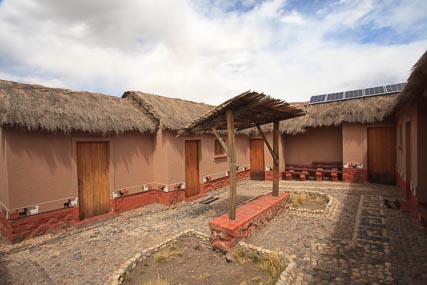
Interior Courtyard, Albergue de Tomarapi

Interior Courtyard, Albergue de Tomarapi

If you are a camper, and come to the experience well prepared, camping might be your best option. There is certainly no lack of interesting places in which you could set up camp, and if you located somewhere not too far from the hot springs . . .

Food is no easier.  If you stay at the Albergue, food is included, and they will even pack you lunch for day trips.  There is a good reason for their policy.  There is hardly any other option for food.  So, if you are not in Tomarapi, or staying in Curahuara, you probably need to bring most of your necessities with you.

Books

Before you head out, you might want to pick up a couple of books that will enhance your understanding and experience.  Guia turistica de / Tour guide of Iglesias: La Paz Y Oruro, by Ambassador Philipp Schauer (former German Ambassador to Bolivia) is an excellent guide to these churches and many others in the area.  It also has the advantage of being in both English and Spanish.  For Spanish speakers, Capilla Sixtina del Altiplano Boliviano, by Father Gabriel M. Antequera Lavayen is THE guide to what is probably the most important of the colonial churches on the Altiplano, the Capilla de Curahuara de Carangas.  Although I will provide important background on all the churches covered here, the Tour guide goes into many others, and there is no way I could give you the detailed interpretation of the Curahuara Church that Padre Gabriel does.

Two posts provide the detailed directions and descriptions of the trip.  See The Churches of Curahuara de Carangas and Sajama: La Paz to Curahuara de Carangas for the first half of the trip (leaving from La Paz) and The Churches of Curahuara de Carangas and Sajama: In and Near Sajama National Park for the second half (or traveling from the Chilean Border).

Overview Map of the Route from Patacamaya to the Chilean Border

Cordillera de Sama Biological Reserve (Reserva Biológica Cordillera de Sama)

Near the Albergue

Near the Albergue

There are many incredible biological reserves and national parks in Bolivia which are relatively little known.  Somehow, those seem to be the ones I usually get to.  The Cordillera de Sama Biological Reserve sits on the edge of the altiplano, above Tarija.  We were driving to Tarija in March, 2013 and took the opportunity to spend a night at the Albergue in the Reserve, the Albergue Turistico Comunal Pujzara.  This Reserve is a place of great beauty and abundant wildlife (mostly waterfowl).  That said, the Albergue is underdeveloped and cccccccoooold!  The beauty of the place, though, is absolutely worth spending a cold night (maybe even two).

The reserve is just 29 miles south off of the road to Tarija, and the turnoff is about 30 miles from Tarija itself (some 18o miles from Potosi).  The altiplano portion of the reserve (the only part we had time to visit) is a relatively humid area with a number of lakes and lots of birds.  All three South American species of flamingo can be found here, as well as a large variety of other birds.

All three species of flamingos that reside in South America can be seen on the lakes of the park.

All three species of flamingos that reside in South America can be seen on the lakes of the park.

Flamingos and Andean Geese

Flamingos and Andean Geese

Black-Necked Stilt, with melanurus trait

Black-Necked Stilt, with melanurus trait

Puna Flamingos

Puna Flamingos

Crested Duck

Crested Ducks

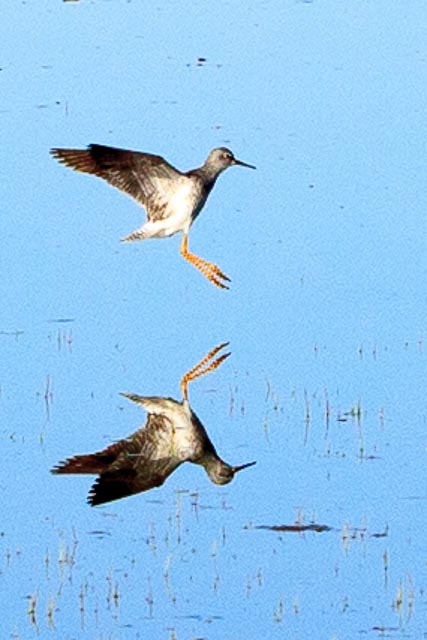
Lesser Yellowlegs

Lesser Yellowlegs

I'd say this is some kind of sandpiper, but which one, I'm not certain

I’d say this is some kind of sandpiper, but which one, I’m not certain

Another shot of the sandpiper

Another shot of the sandpiper

The Albergue is rustic.  Nice looking from the outside, the interior walls are not all finished.  There is no heating, but abundant blankets.  The showers have electric-heated showerheads which are capable of warming the water to a useable temperature (but not really hot), but given the air temperature you are likely to be well chilled before you can get yourself toweled off and dressed after your shower.  The staff, drawn from the local community, can provide meals with advance warning.  When we were there, we were the only guests, and I don’t think you would want to arrive without advance arrangements.  You might just find the door locked and noone around to open it.  That said, the staff were certainly friendly.

Aliciya and Myrna heading back to the Albergue

Aliciya and Myrna heading back to the Albergue

Bedroom in the Albergue

Bedroom in the Albergue

Dining Room

Dining Room

The reserve has a number of other attractions.  There is an Inca road down from the altiplano towards Tarija which would likely make a great trek.  There are sand dunes scattered between the lagoons.  And there is a colonial-era church.  We didn’t have a lot of time, but we did drive a short loop down through the park to get a sense of the place.  One could definitely spend some time here without getting bored.

The Church

The Church

To get to the reserve, turn south from the main road to Tarija at 180 miles from Potosi, or 30 miles from Tarija.  Turn left (East) at Laguna Pujzara, about 25 miles from the last turn.  The albergue is another four miles.  Here is the usual file for use in your GPS or in Google Earth.  The 1:50,000 topo map 6528-I Yunchara covers the central part of the reserve (see my maps page).

The lake by the albergue is not named on any of the maps I have.

The lake by the albergue is not named on any of the maps I have.


Lago Chungara

Lago Chungara

Lago Chungara

Lago Chungara is just across the border into Chile at 14,600 feet of altitude.  In fact, you will be at the lake before you pass through Chilean immigration.

The lake, set among volcanoes, is spectacular and thus often photographed. You should make a point of looking to the south for Nevado Guallatiri (sometimes Guallatire or Wallatiri), a 19,918 foot high ice-covered stratovolcano with an active vent on its south side.  This is one of the most active volcanoes in Northern Chile, and often has smoke rising from its summit.  To the north, looming over the lake is Cerro Parinacota.  In Aymara, the word for hill (cerro) and mountain (montaña) is the same, “qullu,” which explains why so many impressive mountains are labeled as hills on the maps.  Parinacota means “flamingo lagoon” in Aymara, and it is likely that you will see many flamingos standing in the waters of Chungara.  The stratovolcano is 20,827 feet high and is potentially active, though it has not erupted for at least 1,400 years.  It was an eruption of Parinacota, some 8000 years ago, that blocked off the valley below resulting in Chungara Lake.  Behind Parinacota, it’s twin volcano, Pomerape, can be seen over its shoulder from some angles.  Pomerape stands 20,610 feet over sea level.  Of course, older Tata Sajama, at 21,463 feet, remains the granddaddy volcano of the region.

Lagunas de Cotacotani

Lagunas de Cotacotani

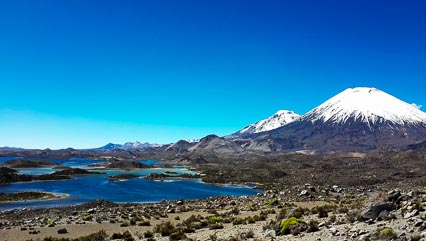
A couple of miles beyond Chungara Lake you will come upon another sight just as striking, though in a different way.  Lagunas de Cotacotani was also formed by volcanic eruptions, but in this case the result is a sprawling mazelike set of lakes and islands in a dry, high desert background with Parinacota and Pomarape, also called los Payachatas (“twins” in Aymara) off to the east.  Of course, you will want to keep an eye out while passing both Chungara and Cotacotani.  According to legend, both lakes were created by the terrific storm unleashed by nature against two local tribes that opposed the love of two of their members.  When the tribes sacrificed the young lovers, the only way they could keep them apart, nature retaliated.  The Romeo and Juliet story ends with the death not only of the two star-crossed lovers, but of all the members of their tribes, the creation of the lakes and of the two volcanoes, which are the lover’s tombs.  The young couple is said to be seen occasionally traveling together in a canoe on one or other of their two lakes.  If you are lucky, though, you are more likely to see the wide variety of waterfowl and the vicuñas that inhabit the area.

Another view of the Lagunas de Cotacotani

Another view of the Lagunas de Cotacotani

On the left side of the road as you pass Cotacotani is a ranger station for Lauca National Park.  If you stop, the ranger will need to register your stop.  In return, you can get a park pamphlet, with a map and have a look at his cheat sheet on the local flora and fauna.  There are often some vendors selling altiplano crafts, but you can usually find a better selection elsewhere.

The ranger station also has public restrooms, but there is no water in them.  There are also public restrooms at the border crossing and at the gas station in Tambo Quemado, both of which might be better options.  The station also has a couple of camping spots for tents (ChP3,000 per tent, including access to bathrooms and potable water).  This is apparently the only place to camp in the park.

To get to Lago Chungara, follow the directions in the article on Getting to Sajama National Park.  From Tambo Quemado you just continue west on the main road to the Chilean Border.