Site menu:

Kalamarka Tribute Concert

k2 On October 12 at the Teatro Municipal al Aire Libre some 15 Bolivian Metal groups will present a concert in tribute to famed folk group Kalamarka. After the metal groups finish, Kalamarka will play. This is an event not to be missed by anyone interested in the music or culture of Bolivia. And I am very proud to say that the US Embassy in La Paz is provided financing to allow the groups to take the show on the road afterwards so that all of Bolivia can enjoy it. K1

For more information, check out: https://www.facebook.com/events/555138287868113/?ref_dashboard_filter=upcoming

Pampas Day 1: Arrival, The Camp, Introduction to the River

It takes almost an hour to fly the 150 miles from La Paz to Rurrenabaque.  Alternatively, you could drive.  The road is almost twice as long, at 270 miles, but is reportedly pretty poor and slow going.  Still, it would be an adventure.  Flying is an adventure, too.  Not the adventure it used to be, of course.  When my friend Ann flew to Rurrenabaque 25 years ago, the plane hit a dog on the runway and she was stuck there for days while they got the landing gear fixed.  Haven’t heard of that happening recently.  Still, I’m not sure it is impossible.

Our party, in front of the airplane

Our party, in front of the airplane

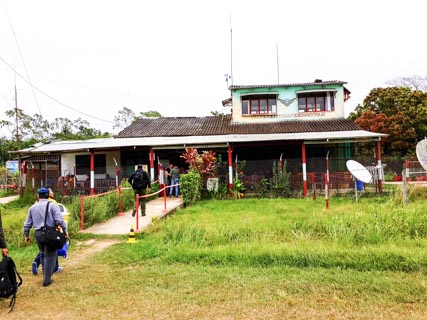
The flight, on the 50 seat Amaszonas Bombardier CRJ-200, was smooth, and the landing dog-free.  The airport in Rurre, as some call it, is small and cute.  We passed through it pretty quickly and found our guides waiting for us with 4x4s for the drive to the camp.

Rurrenabaque Airport Terminal

Rurrenabaque Airport Terminal

It’s a 65 mile drive to the Caracoles Camp, but it takes three hours to get there, as the road is very rough.  I understand that in the rainey season, when the road fills up with water and mud, it can take much longer.  At about 12 miles you enter the Reserva Nacional Lagunas Beni y Pando, so you should keep your eyes open, as you might come across something interesting.  Our driver/guide stopped the car to show us a sloth hanging in a tree by his arms and legs.

Actually, the guide said this was a mother sloth holding it's child, but you have to have better eyes than me to see that.

Actually, the guide said this was a mother sloth holding it’s child, but you have to have better eyes than me to see that.

For about 45 miles you pass through the National Reserve, and a few miles further on you come to the small town of Santa Rosa de Yacuma.  At this point you have almost reached your destination, Caracoles Camp.

Caracoles camp sits on the bank of the Yacuma River in the Area Protegida Municipal Pampas del Yacuma, an area protected by the municipality of Santa Rosa along the banks of the River.  It’s a nice little camp, with cabins both with and without private bath, a large dining hall, and hammocks to lie in when you are resting from your adventures.

Aliciya, enjoying her siesta

Aliciya, enjoying her siesta

After a light lunch, we took off up the river for a short afternoon familiarization tour.

Most of the activity at Caracoles involves taking a boat either up or down the Yacuma River.  Traveling up and down the river, there is an incredible variety of wildlife.  Of course, some of it is constant, and we saw the ubiquitous caimanes, Hoatzins, turtles, capybaras, and Great Egrets on that first afternoon, but other animals and, especially, birds, are different on every trip.

Here are a few of the most common animals seen along the Yacuma River every day:

Capybara, the largest rodent in the world.

Capybara, the largest rodent in the world.


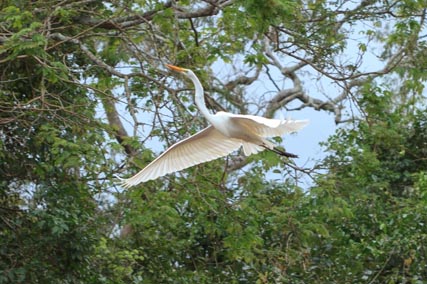
Great Egret

Great Egret


Common Caiman

Spectacled or Common Caiman


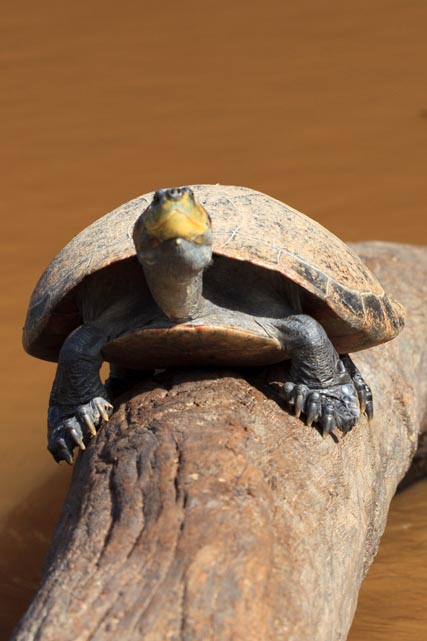
Yellow Spotted River Turtle

Yellow Spotted River Turtle


Rurrenabaque and the Pampas Bolivianas

Sunbathing Turtle on the Rio Yacuma

Sunbathing Turtle on the Rio Yacuma

We spent three days exploring the pampas of Bolivia southwest of Rurrenabaque.  It was a great time and a fun explore.

From Rurrenabaque, there are two directions the tourists take.  You can go upriver into the jungle, or downriver onto the pampas.  Several people, and some online investigation, suggested that the pampas is actually more exciting, as you see more animals because the countryside is more open.  We did see a lot of animals (below).

I can’t say about the jungle (yet), but a trip to the pampas is certainly worthwhile.

The Cabins: comfy, but cool when the temperature drops

The Cabins: comfy, but cool when the temperature drops

We stayed at the Caracoles Lodge, which belongs to Bala Tours.  We were in cabins, with private baths, and they were reasonably comfortable.  Nights were quite cool, and we could have used another blanket, but the bed was not bad at all.  There is no glass in the windows, only screens, which is probably nice when it is hot, but doesn’t provide much insulation from the cold.

There is no hot water, but that’s not too big a problem when the weather is warm (as it was for us after the first day).  Also there is only electricity for a couple of hours in the evening, and no sockets in the rooms, so battery charging is done at a central location.  Best to bring extra batteries and a fast charger, if possible.

The food is quite good, and included in the package.  You pay apart for anything beyond watery juices and water (and water, beyond a certain limit is also charged).   We didn’t skimp, and did pay an extra Bs 400 (about $60).

Of course, you are there for the tours.  I was surprised to discover that the lodge is not in or near a national park or reserve.  Instead, it’s on the xxx.  I’m not sure that makes much of a difference, but the protected area did seem small and we were never to far from grazing cattle.
The lazy Yacuma River

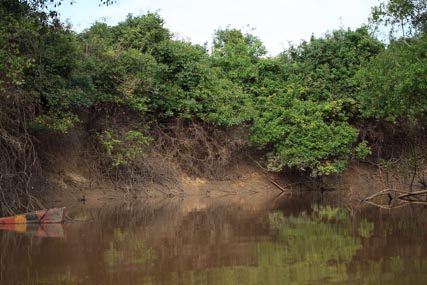
The lazy Yacuma River

Most of the tours, though, are by boat up and down the small Yacuma river, and since the river runs through a narrow depression, you don’t see much of the surrounding area, mostly you are enjoying the flora and (mostly) fauna of the riverbottom.

Most tours to the pampas are two nights/three days.  Since half of your first and last days are used up in travel, it is more like two nights/two days.  We decided to take our time and go for three nights, which I think was the right decision.  Since I expect most tours follow a similar itinerary, I’ll divide the post into the different days.

Pampas Day 1: Arrival, The Camp, Introduction to the River

Pampas Day 2: On the River, Birding, Swimming with Pink Dolphins

Pampas Day 3: Hunting Anacondas, Monkeys, Fishing for Piranas

Pampas Day 4: Horseback on the Pampas, Back to Civilization


A Day on the River

image

First full day on the river in Santa Rosa, Beni, Bolivia.  We went upriver this morning, seeing lots of common caimanes, black caimanes, turtles, squirrel monkeys, capuchin monkeys, many different species of birds and pink dolphins.

image

Our destination was a large, deep pool in the river where the pink dolphins rest and care for their young – a good place to observe, or even swim with them.
We did do some swimming, and though the dolphins showed no interest in frolicking with us, I did get my best look at one of them.

image

We also got up close and personal with a tree full of very cute squirrel monkeys who had no problem coming down to visit us on our boat.

La Casa de la Moneda (The Mint)

image

The incredible and incredibly preserved wooden machinery of the colonial mint

Another unfinished post. I’ll come back to these in La Paz to finish them.

La Casa de la Moneda is one of the most incredible and interesting places I’ve visited in Bolivia. The building itself is spectacular – all the woodwork without a single nail, beautiful stone and brickwork. The equipment for production of coins over 400 years – from the first silver pieces of eight stamped by hand to the coins of the 1950’s.

But the Moneda goes still further. It contains an incredible collection of minerals, the religious items from three Potosí churches, an incredible collection of colonial art and a new display, set to open July 31, of the typical clothing of the various indigenous groups of Potosí department.

Perhaps the single most impressive item in the various collections is the anonymous painting of the Virgin Mary as the Cerro Rico, a painting you will have seen in copies and imitations all over Bolivia. The original is much more powerful. Besides the obvious representation of the Virgin as Pachamama, and the inclusion of the pre-Columbian indigenous sun and moon gods, you can also find the two stories of the discovery of the Cerro Rico depicted.

The Casa de la Moneda is one of the most important visits you will make in Bolivia. I’ve been twice and I’m looking forward to my next time.

Jardines de Mallku Cueva

image

This hotel was a real surprise.  I did not expect such comfort south of Uyuni.

Jardines de Mallku Cueva is in Villa Mar, some x miles south of Uyuni and x miles northeast of the Sol de la Mañana “geyser” field.  That puts it about 90 minutes from Sol de la Mañana, so if you want to actually be there at dawn, you’ll need to be on the road at 5:30 – early, but not a bad deal considering what I’ve heard about the options near Laguna Colorada.

image

Anyway, to get back to the hotel, Jardines is built onto the bottom of a cliff face and at least one of the rooms has the stone of the cliff as one of its walls. It’s pretty cool looking.  The rooms are not big, but when keeping warm is a top priority, that’s an advantage.  They have water-based radiator heating in bedrooms and bathrooms, which is nice, and electric blankets for those really cold winter-at-13,500 ft. nights.  Tonight the mercury is expected to hit 12° F.

The food is is also very good with dinner and breakfast buffets included in the rate and a staff that seems to make every effort to be helpful.

Uyuni to Villa Mar

This drive takes you south from Uyuni towards the colored lakes of Los Lipez.  Start out along Highway 5 from Uyuni.  Villa Mar is the location of the very pleasant Jardines de Mallku Cueva hotel, a great jumping off point for further explorations. 

At x miles is the unmarked turnoff to the right to the Train Cemetery.  Beyond the cemetery you follow the south shore of the Salar for some x miles before turning south.  The south shore is mostly a huge mudflat, likely flooded in rainey season and prone to duststorms in dry times.

After turning south, keep your eyes out for vicuñas.  At x miles is the left turn to San Cristóbal.

San Cristóbal is the company town of the mine of the same name.  The San Cristóbal mine is a huge open pit zinc/lead/silver mine owned by Sumitomo.  The town is interesting mostly for its large and beautiful stone church, which reportedly sports a silver alter.

The drive south from San Cristóbal is not very exciting for the first x miles.  The landscape continues flat with a light scrub desert.  However, that changes at about mile x from San Cristóbal.  From that point on you will see interesting rock formations on the left side of road.

image

The formations, weathered out of sandstone are fun to explore and certainly worth hiking through, if you have time.  They continue all the way to Villa Mar and even form one side of the Jardines de Mallku Cueva hotel, so if that is your destination, you will probably have time to explore them.  On our short walk we found slot canyons winding through the rock, as well as numerous hoodoos and one small natural arch.

The Train Cemetery

The Train Cemetery is not a train museum, even one with limited maintenance and development like the one in Putumayo.  No, the Train Cemetery in Uyuni is where trains end up after they die.  Don’t let that put you off, though, it’s a blast.

The cemetery is an open air space with the remains of numerous trains. In most cases, they are just sitting there waiting for someone to climb on them,  but welders and other artisans have had their way with some, and there are a couple of swings and other such as a result.

There’s not much more to it, but that’s enough. Most people will likely enjoy a short stop here and some unique photos can be shot of the  metalic hulks.

As at many tourist attractions in Bolivia, safety is not really a consideration.  In this case, you probably want to ensure that your tetanus vaccination is up to date.

Luna Salada

image

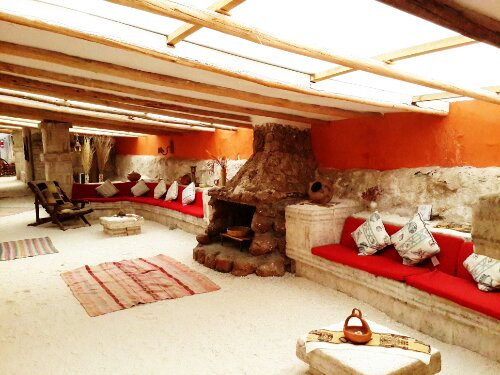
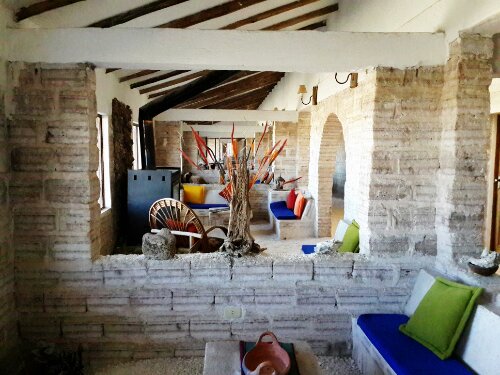
Luna Salada is probably the premier hotel at the Salar de Uyuni.  Constructed almost entirely of salt blocks, it has the local uniqueness factor down, but it also doesn’t skimp on the most important aspects of comfort.

The hotel is beautiful from the inside. The whites and grays of the salt blocks and rock salt floors are set off nicely with local tapestries and other decorative elements pleasing to the eye.  From the outside, unfortunately, the hotel still looks like a construction zone, and while that may be alright, given that construction is still underway, it doesn’t look like it will be overcome anytime soon, if ever.

image

The most important comfort factor at the Salar is heating, and Luna Salada has heating down.  In the rooms, they have triple redundant heating systems, gas, water-convection, and electric blankets.  If one of them fails, you’re still going to be warm. If the gas makes you nervous, they can provide a nice electric space heater to replace it.

Rooms come with an excellent buffet breakfast and a delicious and varried buffet dinner is also available for additional cost.  The chef is excellent, and he wanders among the tables ensuring that diners are enjoying his food.

The way in which wifi is handled is an unfortunate choice. Free wifi is available only in the lobby, and is quite poor. There is also a paid network, which is presumably much better, but at the Salar, where most people spend the day out and just want to post an update on Facebook at the end of the day before crawling into bed, it seems like that should be made a bit easier.

All in all, Luna Salada makes for a comfortable Salar adventure.

Salar de Uyuni

image

The Salar is perhaps the premier tourist destination in Bolivia.  I’ve been there three times and I don’t think it gets old.  It does get cold.

Most people use a tour agency and guide to explore the Salar, but
I never have, so I can’t help with that side of things.  However, I can give you much rarer information on how to explore the Salar on your own.

First, though, you probably should consider your personal risk tolerance.  Getting lost on the Salar should be very hard to do.  The Salar is imense, but not that imense, and as long as you have a car with reasonably well aligned steering, you can put your hands at two and ten on the wheel and you’ll soon find the edge of the salt.

More serious is the possibility of your auto breaking down.  If that happened in an out of the way place, or at the end of the day when everyone else was gone, you would be in for a cold night, at best.  The solution is two cars, always a good idea when traveling in remote areas.

Of course the other risk is breaking through the salt. That’s another good reason not to travel alone, but it doesn’t seem very common.  Mostly the danger of breaking through occurs on the edge of the Salar where the crust is thin.  You should never attempt to take a vehicle onto or off of the Salar except at one of the established entry points.

OK, I’ll have to finish this in La Paz.