Site menu:

Inside Cerro Rico

image

The mine tour in the Cerro Rico de Potosí is not to be missed if you can handle the physical demands and the tight spaces involved.  I’ll provide more details later, together with my recommendation for a tour guide, but for now, just a few reflections about the tour and the mountain, itself.

Legend has it that the name Potosí comes from the Aymara word for “thunder”. The story depicted in the famed anonymous painting of the Virgin Mary as the Cerro Rico has the Inca Emperor at the mountain. According to legend, when the Emperor’s servants attempted to extract the silver which lay native on the mountain a loud clap of thunder scared them off.

The same painting also depicts the discovery of the silver by the Spanish, who were apparently luckier. Out chasing run away llamas, the Spaniards lit a campfire, only to find rivulets of silver running from it.

Whatever the truth of the discovery of the riches of the Cerro, it is clear that they brought greater luck to the Spanish than they ever have to most locals. The Spanish extracted huge quantities of silver from the mountain, financing their empire for more than two centuries. In contrast, some xxx indigenous slaves died in the hard labor of the mines, wielding picks, shovels and later, black powder. And by the time of independence, the highest grade ore was gone.

But the mine, now mines, as there are 420 today, continue to operate. When the Bolivian government shut them down with the fall in tin prices (besides silver, Cerro Rico has been an abundant source of tin, zinc and lead), the miners reopened the mountain reorganized into cooperatives.

Today, the cooperatives rule the mountain, literally. The 420 mine entrances are each controlled by a cooperative. That said, the very real power of the cooperatives should not lead anyone to believe that the mining is done on anything resembling a cooperative basis.

The cooperative members operate much like small business owners. They make the decisions about the operation of their portions of the mine, hire, supervise and pay their employees, and, perhaps most importantly, shoulder all the economic risk.

Most cooperative members have two decades or more experience in the Cerro. They decide where to drill and blast in their areas, and when all the operating costs and salaries are paid, they take home any remaining earnings.

Usually, a member, otherwise known as a first class miner, will hire a second class miner to drill and blast and a number of third class miners to do the manual labor of transporting the ore out of the mine. Salaries change over time mostly in response to changes in the prices of the metals (and thus the ores) being produced. As of July, 2013, the daily rate for a third class miner had fallen to Bs100 (US15) from Bs150 six months earlier.

The work and the conditions of work probably have the greatest impact on visitors.

Tours : options

Religion : el tío vs Catholicism – Pachamama

Potosí

image

Today we drove from Sucre to Potosí. Tomorrow Christina, William and I will take the mine tour down into the famed Cerro Rico. Wish us luck!

Cal Orck’o and the Cretaceous Park

image

We visited Cal Orck’o and the Cretaceous Park this morning. It’s definitely a worthwhile stop in Sucre, and from the management we understood that it will be getting even better.

Cal Orck’o is the site of a major cement plant of the disputed Fanesca cement company. It is also the quary where Fanesca gets its gypsum and where they have found thousands of dinosaur footprints.

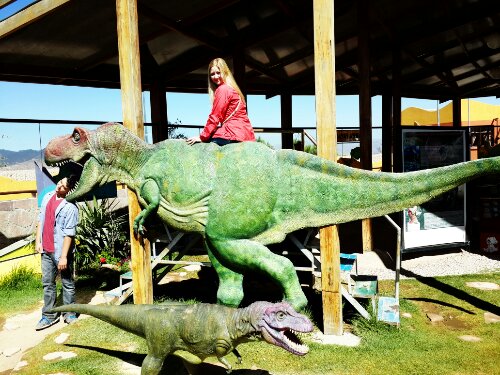
The company donated land next to the quary which the city has turned into the Cretaceous Park, with numerous life-size dinosaur statues scattered over the hillside. Not surprisingly, the kiddie portion of the park is the most fun. Kids can play various games, solve puzzles, and get their photos taken with more manageble-sized dinos.

The most disappointing aspect of the site is the lack of access to the quary itself. My guidebook bought the rather strained official explanation: that the quary is off limits in order to protect the dinosaur tracks. That is obviously untrue, since the tracks are laid out on a vertical stone wall and almost all of them are hundreds of feet out of reach.

At present, visitors have to content themselves with the poor view from a few token-operated binoculars. We were lucky enough to get a tour by the park management and were pleased to find committed people with a plan for improvement. As it turns out, the real reason why the quary is closed to visitors is that, until very recently, it was still operating as a quary for the cement company. Happily, the company has agreed to close the part of the quary closest to the park and work has begun preparing it to receive visitors.

Hopefully, people will soon be able to get a better look at the tracks, which include the longest continuous set of dinosaur footprints in the world, as well as tracks by various species.

Sucre

image

We’re in Sucre, our first stop.  If you haven’t been to Sucre, you certainly should go.  It’s a beautiful whitewashed colonial city of great historical importance.  It’s a pleasure to walk, has at least one great hotel, and a number of sights well worth visiting.

We got here this morning and immediately checked into the hotel Parador Santa Maria La Real, one of our favorite hotels in Bolivia.  The Parador is a beautifully restored set of colonial buildings furnished with antiques just a few blocks from the Plaza 25 de Mayo, the central plaza of Sucre.

At less than 10,000 feet of altitude, Sucre enjoys a climate somewhat more temperate than altiplano Bolivia. When the sun is out it seems positively balmy.

On this visit we had a bit more time to explore the city. We visited two interesting textile museums and Cal Orck’o/Cretaceous Park. We also spent some time just walking the streets and enjoying the colonial architecture.

Museo de Instrumentos Musicales

image

This is our favorite museum in La Paz. It’s especially fun for kids, since there are many instruments you can play and play with. The number and variety of instruments is impressive.

The museum is at the bottom of Calle Jaén which is well worth exploring anyway.

Aymara New Year at Tiwanaku

The Aymara new year tradition is quite different from those I have been accustomed to in other places. Rather than celebrating the night before, culminating at midnight, the Aymara celebrate at dawn on June 21 (winter solstice here in the southern hemisphere). This morning, I was up at 4 am to prepare for the drive out to Tiwanaku for the new year celebration.

Thousands of people were gathered at Tiwanaku, but of course that is not the only place to celebrate.  In fact, on the way there we passed over a ridge and I saw hundreds of people gathering there to see the sun come up over the eastern range of the Andes and make their ritual offerings to ask for the blessing of the god(s) for the coming year.

Tiwanaku played host to the President and Vice President of Bolivia, the Minister of Culture, the Governor of La Paz, and many other high officials.  A good share of the Diplomatic Corps also braved the cold.

The President and Vice President, as well as other officials, placed offerings on the pyre.

The President and Vice President, as well as other officials, placed offerings on the altar.

After all the offereings had been placed on the altar, the yatiri, or holy man, lit the fire and said a prayer.

After all the offereings had been placed on the altar, the amauta, or holy man, lit the fire and said a prayer.

The prayer was given in Aymara, with translation into Spanish.  I could pick out words here and there in the Aymara, but can’t understand it yet.

It was a beautiful dawn. This is the wiphala, one of the two official flags of Bolivia (and the traditional flag of native peoples of the Andes) against the sunrise.

It was a beautiful dawn. This is the wiphala, one of the two official flags of Bolivia (and the traditional flag of native peoples of the Andes) against the sunrise.

Sunrise
Sunrise

Everyone's hands in the air, celebrating the arrival of father sun and of the new year, 5521 by the traditional Aymara count.

Everyone’s hands in the air, celebrating the arrival of father sun and of the new year, 5521 by the traditional Aymara count.


Metal Club in El Alto!

El Alto


Last night we went up to El Alto to check out the famed Oveja Negra rock bar, see one of our favorite bands and a couple of others.  As usual, we had a fantastic time.  We got there a little late, so missed Morbogore, but caught Angaros’ set, which was very good, and Armadura, of course.

The Bolivian Metalheads treated us as honored guests, as we have come to expect.  El Alto is not a place most Paceños will go to for the nightlife.  Certainly not many diplomats will be found up there after dark (unless on their way to or from the airport).  And, as Boris Mendez, the lead singer of Armadura said, “Oveja Negra is the most ‘underground’ place you will find in La Paz.”  (Though it was up two flights of stairs from the street — watch your heads.)  We were greeted by acquaintances and new friends with hugs and offers of drinks (singani and sprite being the concoction most in evidence).  The club was packed with people and smoke-filled.  The music was hard rocking and the crowd was very into it.

We had a great time.  For me, as for most of the crowd, the highlights were two covers and one original composition of Armadura.  Their cover of Hijos de Cain (Children of Cain) by Spanish hard rockers Baron Rojo is spectacular.  Their cover of the Ama sua, ama llulla, ama kella (Thou shalt not steal, thou shalt not lie, thou shalt not be lazy) by Bolivian folk greats Kallamarka is one of my very favorite new (even if just to me) songs.  The conversion from folk song to hard rock is fantastic.  Finally, their own hit, Premonición, always gets the crowd going.

I managed to record a video of Ama sua, ama llulla, ama kella, and though neither the video nor the audio quality do the concert justice, they do give you a sense of the venue, the band, and the excitement.  And don’t miss a highlight at 5:30.

[flv]http://memmott.us/blog/wp-content/uploads/2013/06/DSCN3643-2.flv[/flv]

Upgrading to a Garmin Oregon GPS–Yes, Do It

91c3zV4wtZS._SL1500_So, I finally broke down and got a Garmin Oregon 450.  This is not a review.  There are lots of reviews out there, anyway, and you can find all the details about the unit on the Garmin site.  Instead, my point here is just to mention its usefulness in the Bolivian context (or that of any other out of the way, difficult to map, place), which, in my view, is where the Oregon shines, and perhaps to help people get the most of the unit if they buy it.

I’ve had a Garmin eTrex Vista HCx for some years now, and I swear by it.  It’s a great unit.  It’s shown me the way, or at least tracked my paths, across much of Kyrgyzstan and wide swaths of the USA, Ecuador, Kazakhstan, Uzbekistan, and even Bolivia.  Maps are always the problem in these places (well, except for the good old US of A), but Open Street Map and various extensions from OSM have filled the gap handily, if not by any means completely.

The Oregon 450 has a much larger and nicer touch screen, is much easier to use, has all kinds of gimmicks and facilities (like 3-D view and customizable profiles), but the real reason for moving to the Oregon 450 (or one of its brother units) is the ability to install custom maps on it.

The custom maps feature means that you can put any map you can get a scan of onto your GPS (with some limitations, more on that below).  In Bolivia, where the Instituto Geographico Militar has put its whole collection online, that is a real bonanza.  And the facility works well, with the following caveats:

1.  The size limits are pretty restrictive.  Only jpg files are accepted (no progressive scan), they must be smaller than 3 mb, and images over 1 megapixel (1024×1024 pixels, 512×2048 pixels, etc.) render at a degraded resolution.  The maximum resolution is 155 dpi.  In practical terms, that seem to mean that I can get about 1/32 of a Bolivian 50k topo map on a single jpg tile.  That is something under 5×5 km.  Not very useful for driving on the roads, but not so bad for hiking or treking.

2.  The workaround, is that up to 100 custom maps can reside on your Oregon (500 on some premium units), so, with a fair amount of work (more on that below) you could cover, what, 500x500k?  That’s respectable!  An unlimited number of files can reside in one “kmz file envelope (up to the limit of 100, I suppose).”

3.  The learning curve for getting this done is not undemanding.  The process for going from a 5x5km cuadrangle of an IGM .pdf 50k topo map is as follows (with software recommendations, where necessary):

a.  Download your map from the IGM site.

b.  Convert the file to a .jpg.  There are dozens of converters available online.  The one I use, PDF Converter v1.26, is very simple, but I’m afraid it may not be available any longer.  It’s publisher is now offering the ImagePrinter Free, which seems like it might do the job, as well.  If you are going to do this with a lot of maps, it might be worth getting something with batch capabilities.

c.  Cut the file down to the right size and convert to the right dpi (155).  I use Adobe Lightroom 4 for this, since I have Lightroom on my computer for my photography anyway.  It does the job very well.  That said, there are probably better applications for this purpose.  You want to take some care here.  The next step will be geo-referencing the image in Google Earth.  Though that always involves some adjustment, regardless of how you start, it will be significantly easier if you start from an easy to recognize set of geo-coordinates.  For that reason, I try to crop the maps on well defined latitude and longitude coordinates.  The UTM coordinates are marked better on the Bolivian maps, but they are complicated to convert and only partially supported in Google Earth, so using them is much more difficult.

d.  The rest of the job is done in Google Earth.  Find the approximate location where your map goes, and click add/image overlay.  In the dialogue box that opens, put a name for the map, and then link to your map jpg.  Use the “location” tab to input the lat/lon of the edges of your jpg.  Fiddle with the transparency slider to see how the map lines up with the satellite imagery below.  This is a major disappointment.  I have no idea why (somebody tell me!) but the maps are NEVER actually lined up.  In fact, all geographic locations are always too the north, on the map, of where they show up in Google Earth.  As far as I can tell using the GPS, Google Earth is right, and not the map, so move the overlaid map around until the lakes and roads match.  Once you have the overlaid jpg file where it belongs, go to the altitude tab.  Change the Draw Order, which defaults to 0.  To get it to draw on top of the base map on the unit, the draw order should be more than 50.  Finally, hit Ok to save your work.

e.  You’re almost there.  The map has been saved in the “Places” list on the left.  You can put multiple maps into a folder in that list, and then right-click on anything to “save place as.”  Browse to your connected GPS and save the resultant kmz file to the Custom Maps directory (under the Garmin directory).  When you turn your GPS on again, if you did everything right, your new custom maps will be available.

An area near Zongo that I am planning to explore, with the map loaded into Google and ready to upload to the GPS.

An area near Zongo that I am planning to explore, with the maps loaded into Google and ready to upload to the GPS.

Another Hint

Custom maps are great, but they are a lot of work.  You can improve your Garmin GPS experience in places without top flight (and expensive) Garmin maps by going to mapas.alternativaslibres.es.  Here you can get excellent, routable maps, based on Open Street Map, AND altitude contour lines courtesy of NASA/JPL-Caltech.  And we all know that altitude is crucial in Bolivia.

Have fun.

Jesus de Machaca Church and Archaeological Sites

_MG_3012The church in Jesus de Machaca looks quite different from other churches on the altiplano.  It also looks quite out of place for such a large and sumptuously decorated church to stand in such a small town in such an apparently poor region.  With its whitewashed facade and blocky look this church is an example of late renascence architecture.  German Ambassador Philipp Schauer has done a great job describing it in his book, Tour Guide of Iglesias Rurales: La Paz y Oruro.  He also gives a great deal of information on the history of the church and the area.  Definitely worth reading during your visit.

Keeping it very short, the answer to the mystery of this church is that it was financed by a rich local indigenous leader and his family, who the Spanish left in charge of the area and who was thus able to amass a large fortune.  The fortune can be seen in the quality and size of the construction, and in the interior, which is very nicely ornamented.  Also, unlike in many of the churches, this one seems pretty much intact.  When we were there, there was even maintenance underway inside.

Note scaffolding on the right

Note scaffolding on the right

 Archaeological Sites

The area around Jesus de Machaca is populated with numerous archaeological sites of importance, some of which date back to the period prior to the rise of the Tiwanaku civilization.  I have not had a chance to explore these sites, so I can’t say how much there is to see, but you might start your explorations by taking a look at the website of the Grand Machaca Archaeological Project. (The last time I checked, this website was down, but I’ll leave the link up in case it comes back up again. In the meantime, take a look at the archived version.)  Among the sites listed are:

Ruins of Huancane in the Comunidad Qhunqhu Liquiliqui (Khonko Likiliki), just a bit north of 68 °40′, 16 °50′.  This location is shown on the 100k Instituto Geographico Militar map 3137: Puerto Guaqui, available online (see Maps in Bolivia).

Fortress of Qhunqhu (Pukara de Khonkho), directly north of the Ruins, in the proximity of Rosa Pata.

Ch’auch’a de Kulla Marka (Chaucha de Kulamarka), also close to Rosa Pata.

Iruhuito, near the Desaguadero River.

For directions to Jesus de Machaca, see Tiwanaku, Colonial Churches and Natural Arches.


Natural Arches Near Tiwanaku

Both natural arches

Both natural arches

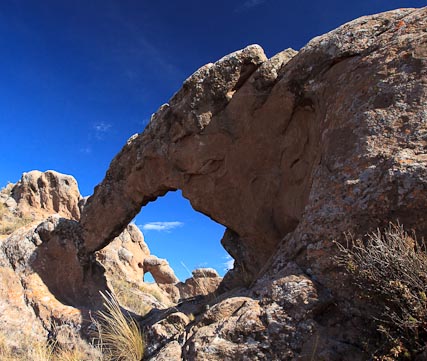
Maybe it should not have surprised me to find natural arches in Bolivia.  After all, the scenery is often reminiscent of that of Utah, my home state.  Still, it was a big surprise to look up from my sandwich as we picnicked on a rock outcropping south of Tiwanaku and see two natural arches.  They are only a few minutes hike from the road, and they really are quite nice.  Maybe not worth a trip in themselves, but if you are at Tiwanaku, you certainly should not miss them.

For directions, see Tiwanaku, Colonial Churches and Natural Arches.

Alex, framed in the arch

Alex, framed in the arch